What Factored’s Work With Fortune 500 Teams Reveals About Building Durable AI Advantages
The Executive Imperative
The leap from AI tools to agentic systems has captured the imagination of enterprises everywhere.
To win, your competitors are not ignoring data readiness; they are prioritizing the right data foundations first.
In the last 90 days, Factored has helped Fortune 500 organizations deploy agentic systems on top of hardened, production-grade data layers: clear ownership, trusted sources, governed access, even while broader modernization continues. These teams are already realizing 30–50% operational cost reductions.
Agentic AI doesn’t fail because the models are weak; it fails because the data isn’t ready.
Without mature, connected, and contextual data, agents lack the awareness and grounding needed to make decisions safely and effectively. Agentic AI depends more on a data layer that provides continuity, feedback, and trust.
Key Insights:
- Data maturity is the true infrastructure for autonomy. Models can generate; data enables informed decisions and action.
- Most enterprises overestimate readiness. They mistake data availability for data usability.
- Agentic AI forces convergence. Data engineering, machine learning, and systems design can no longer operate as silos.
- The next frontier isn’t larger models, it's smarter data.
Gartner also finds that lack of data maturity, not model capability, is the primary blocker to scaling autonomous AI systems in the enterprise.
Recommended Actions
- Build a continuous data feedback loop, because agents can’t improve on static context.
- Establish context pipelines that unify operational, semantically rich data.
- Treat data quality as an architectural principle, not a compliance exercise.
The Real Bottleneck: Data, Not Models
Enterprises today claim to be “AI-ready.” But readiness isn’t about having data; it’s about having data that AI can reason with.
Models are only as intelligent as the context they’re given. If data is fragmented, outdated, or inconsistent, agentic systems behave erratically. They hallucinate because they’re operating blind, lacking reliable signals about the world they act in.
The bottleneck isn’t model complexity, it’s data maturity. Most enterprise data stacks were built for analytics and not for autonomous decision-making.
Why Agentic AI Breaks Legacy Data Architectures
Traditional data infrastructure was built for reporting, not reasoning.
Pipelines were linear: extract, transform, load, visualize.
Agentic AI demands something different: bidirectional data interaction and dynamic context.
Instead of one-way movement from source to dashboard, agentic systems require:
- Real-time feedback loops between actions and outcomes.
- Context persistence, where memory evolves with every interaction.
This is where many agentic deployments stall. They run autonomous systems on batch-oriented, static pipelines, the equivalent of teaching a robot to navigate with last week’s map.
The Six Pillars of Agent-Ready Data
To move from experimentation to enterprise-scale autonomy, organizations must build data systems that are designed as dynamically as the agents they enable.
1. Accessibility
Agents must query and retrieve data across systems without human mediation.
→ Requires standardized APIs, meaningful metadata, and role-based data access control.
2. Contextuality
Data must carry meaning, schema, lineage, and relationships, so agents can infer intent.
→ Implement semantic layers and vector search for contextual grounding.
3. Temporal Awareness
Static snapshots are useless for dynamic reasoning.
→ Data must be kept up to date, and records of previous interactions should be made available for agents to make better-informed decisions.
4. Feedback Integration
Data must capture both decisions and outcomes to enable reinforcement loops.
→ Treat model and agent outputs as important data sources.
5. Observability
Enterprises need visibility into how agents consume and modify data.
→ Logging, versioning, and traceability frameworks are essential for trust.
6. Governance
Data governance must evolve from access control to semantic guardrails, ensuring AI acts within defined boundaries.
→ Policy-as-code and automated compliance pipelines enable scale.
Continuous Evaluation: The Missing Feedback Loop
Traditional AI development treats deployment as the finish line. For Agentic AI, deployment is where learning begins.
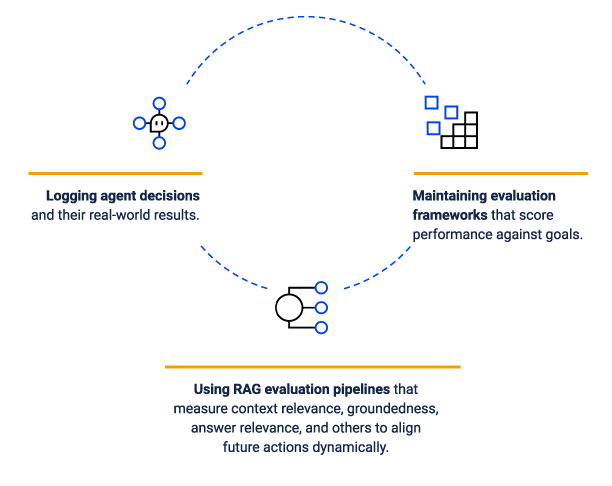
To work effectively, agents need continuous evaluation loops that monitor decisions, validate outcomes, and feed corrections back into the system.
Without that loop, agents degrade over time, acting on outdated patterns or drifting away from the business context.
Continuous evaluation requires:
The New Maturity Model: From Simple Delivery to Agency
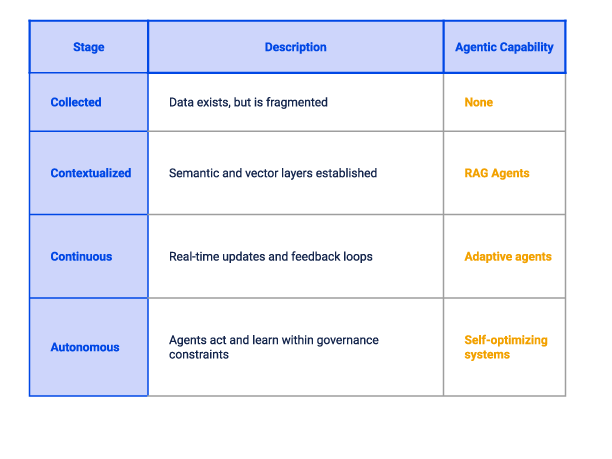
Data maturity now defines AI maturity.
Winning enterprises do not bypass data readiness. They focus on it, advancing to agent-ready data stages in high-impact domains first, then scaling outward. This compresses time-to-value.
Legacy data analytics infrastructure focuses on reporting: data delivery, periodic ETL jobs, nightly reports, and quarterly insights.
Agents don’t only deliver or consume data, they also make decisions and perform actions, which require real-time data, persistent context, and self-correcting feedback.
Governance: The Foundation of Trust
Autonomous systems demand autonomous governance.
It’s not enough to restrict access; enterprises must monitor and enforce agent behavior at scale.
This requires three capabilities:
- Policy enforcement at runtime: ensuring agents only act within approved contexts.
- Traceability: recording every decision and data interaction.
- Reliability: fail-safes that prevent cascading errors or feedback loops.
Governance is the new reliability layer. Without it, autonomy can lead to disaster.
The next decade of AI advantage will come from better data systems
Leaders must not only ask, “What can my agents do?” but, more importantly, “What data do they depend on?”
To succeed, enterprises should focus on:
- Continuous Agent Improvement—connect data, feedback, and evaluation pipelines.
- Design for context—make data self-descriptive and semantically rich.
- Operationalize governance—treat policy and observability as code.
- Measure progress by autonomy, not adoption.
Your competitors are not skipping data readiness. They are operationalizing it faster and more strategically.
Factored helps Fortune 500 organizations make their data agent-ready. Those who master that foundation will build systems that not only reason but also improve themselves, gaining a competitive advantage that lasts.