Why Factored’s Trials Reveal a New Competitive Moat
The Executive Imperative
AI coding assistants are force multipliers for teams that treat them as collaborators, not shortcuts.
A small set of Fortune 500 organizations has already operationalized agentic coding assistants as strategic infrastructure, compounding 20–40% productivity gains QoQ according to McKinsey. This is no longer a tooling decision. It’s an execution-velocity race.
The question is “How far ahead are competitors who already deployed them at scale?”
Over 30 Factored engineers tested three agentic coding assistants in Q4 2025: Claude Code, Cursor, and GitHub Copilot. We wanted to measure their impact on developer productivity, code quality, and workflow efficiency.
Key Findings:
- Claude Code led in usefulness and reliability.
- Cursor showed the highest speed and task automation.
- 100% of participants would recommend AI coding assistants to peers.
- Issues Remain AI coding assistants require a human in the loop to be effective
Recommended Next Steps:
- Pilot assistants in repetitive tasks or when building from scratch.
- Pair senior engineers with AI copilots and track PR metrics and time.
- Scale adoption with proper governance, training and data safety policies.
Every quarter spent avoiding or evaluating, rather than deploying, leads to slower release cycles and missed roadmap commitments, while competitive gaps continue to compound.
AI Assistants Can Become an Engineer’s Execution Partner
Adoption data shows a positive impact across all three assistants, with Cursor slightly ahead. Every tool found advocates, signaling that engineers are ready for structured rollout when governance and enablement are in place.
“This is a great tool. It definitely helped me generate repetitive code and save hours.”
-Software Engineer, Factored
Which coding assistant(s) have you been using during this trial?

Different Tools, Different Philosophies
AI coding assistants are not interchangeable. Each tool represents a different view of how engineers should work, and those differences shape real-world outcomes.
IDE-Native vs. Terminal-Native
- Cursor and Copilot extend the traditional IDE. They sit inside VSCode-like environments, enhance code completion, automate tasks, and accelerate iteration loops. Their philosophy: level up the workspace developers already use.
- Claude Code takes a completely different approach. It isn’t an IDE; it operates through a terminal-style interface that can explore and edit entire repositories with natural language. It handles multi-file changes (10s to 100s of files) and clearly displays diffs and reasoning steps.
These tools solve different parts of the engineering workflow:
Cursor/Copilot → fast iteration, IDE-native flow, task automation
Claude Code → repo-level reasoning, large-scale refactors, multi-file edits
Enterprises that align assistant philosophy to workflow maturity are already shipping 4–6 additional features per quarter with the same headcount. GitHub reports developers using Copilot complete tasks up to 55% faster, directly increasing feature throughput without added budget. Within 12 months, this delta can become a structural moat.
Executives evaluating these tools should think in terms of:
“How much control do we want our engineers to have?” IDE agents allow step-by-step changes, while terminal-native provides all features with little intervention.
Choosing the right assistant is less about brand and more about workflow fit.
Confidence Rises When Code Quality Improves
Across the three tools, average usefulness ratings exceeded 3 out of 5, led by Claude Code, signaling strong perceived value in daily engineering workflows.
This indicates that AI coding assistants have crossed from novelty a year ago to a competitive advantage today.
The best-performing assistants balance accuracy with learning support and final decision on code being reviewed by Engineers, enabling contextual reasoning and reducing bugs.
For junior engineers, these tools accelerate development but increase the risk of reduced quality control.
Key Takeaway:
The next generation of coding copilots is defined by reliability, not just speed.
On a scale of 1 to 5, how useful have you found the AI coding assistant(s) in your daily work?

Productivity Gains Are The New Default
Nearly every respondent reported increased productivity with “Significantly Increased” as the dominant response.
Cursor users emphasized faster iteration loops and automation of repetitive tasks, while Copilot users highlighted reduced friction in context switching.
Executive Insight:
Organizations should benchmark assistants against metrics like time to feature and review velocity.
“Claude is great when you have an idea of what you want to build, it accelerates structured coding.”
— Backend Engineer
To what extent do you agree with the following statements regarding the AI coding Assistant (s)

Developer Advocacy Predicts Faster Org-Wide Adoption
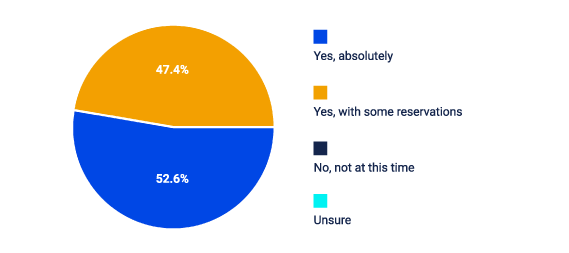
Over 52% of Factored engineers said they would “absolutely” recommend AI assistants to other engineers. About 47% said yes with reservations, but still, 100% said “yes.” That’s broad advocacy.
Strong internal advocacy lowers the cost of cultural adoption. When engineers lead the change, rollout friction is reduced by months.
Strategic Implication:
Form an AI Developer Guild — a cross-functional group that tests, measures, and defines internal best practices.
To what extent do you agree with the following statements regarding the AI coding Assistant (s)
Engineers Want Enablement, Not Replacement
The motivations behind adoption reveal a deeper truth: Engineers want a collaborator.
Top motivations included:
- Boilerplate creation
- Debugging acceleration
- Testing support
- Learning new coding patterns
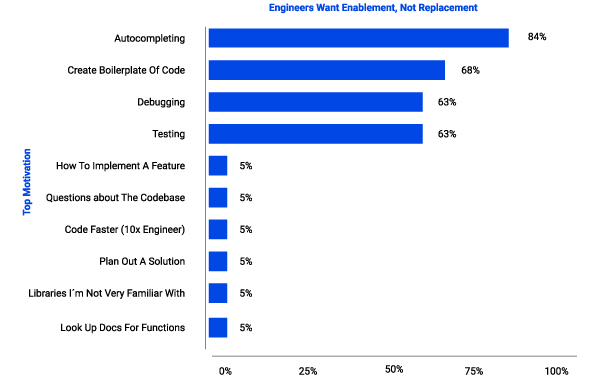
The language of these responses emphasizes collaboration on time-consuming, potentially boring tasks.
The best assistants will evolve into context-aware collaborators, deeply integrated into IDEs, version control systems, and CI/CD pipelines.
Adopt What Works, Measure What Matters
Insights from the Factored AI Assistant trials:
- 30+ engineers participated across multiple teams.
- Claude Code ranked highest for code understanding.
- Cursor led in iteration speed and automation of repetitive tasks.
- Developer trust is high — over 85% strong recommendations for their tested tool.
Implication:
Adoption barriers are low. ROI now depends on structured scaling and measurement.
Executives should focus on repository-level metrics such as:
- Time to feature
- Review velocity
- Test coverage deltas
Scale With Discipline, Not Hype
Five steps for responsible AI coding assistant rollout:
- Human in the loop - Keep the Senior engineer for validation of the AI Assistant
- Measure The Delta — track pre- vs. post-assistant performance.
- Create A Safe Sandbox — define rules for cloud credentials, data, and licensing.
- Scale With Guardrails — standardize prompt templates and model versions.
AI copilots are now part of the modern tech stack.
Factored has deployed production-grade agentic systems across Fortune 500 organizations. Our clients avoid the 12–18 month learning-curve and begin realizing measurable productivity and cost reductions in 60–90 days. This is consistent with industry benchmarks for production AI impact (McKinsey; BCG).
This is strategic execution that enhances competitive advantage.