Why Factored’s Deployments Reveal the Next Frontier in Competitive Velocity
The Executive Imperative
Agentic AI is the reason your competitors’ data and platform teams are shipping 2–3× faster with the same, or smaller headcount (BCG, 2023; McKinsey, 2023). This is no longer a technology discussion. It is a competitive execution gap.
Factored’s elite engineers have been working with AI as it evolves from a tool that responds to prompts into a system that plans, decides, and acts autonomously. Agentic AI marks the moment when organizations stop orchestrating intelligence manually and start engineering systems that self-orchestrate.
This transformation, from assistance to agency, represents one of the most profound shifts in how we engage with technology.
The question Fortune 500 leaders are asking privately is “Which of my competitors have already operationalized this and how far behind am I?”
Key Insights
- Agentic AI is infrastructure, not an interface. It will be an integral part of data infrastructure rather than just a way to query static data.
- The Model Context Protocol (MCP) is an effort to standardize communication in AI agentic systems, allowing connections between models, tools, and APIs across platforms.
- Autonomy depends on architecture. Reliability, security, and context-sharing determine how scalable an agentic system can become.
- The next competitive advantage won’t come from deploying more models, but from designing intelligent systems that can reason, act, and learn.
Recommended Actions
- Map which processes should evolve from static automations to goal-driven agentic workflows.
- Define a shared governance and observability framework before scaling.
- Treat AI as part of your core infrastructure strategy, not as a productivity add-on.
- Agentic AI should have a human in the loop and be leveraged as a force multiplier, not as a replacement for your engineers.
Every quarter spent “aligning” instead of deploying compounds execution debt. McKinsey finds early AI adopters build organizational learning curves that late movers cannot close through hiring or tooling alone.
From Individual Tools to Collaborative Systems
The early era of AI revolved around autocomplete, chat interfaces, and narrow copilots. Those tools accelerated individual output, but they didn’t change how systems operated.
Agentic AI addresses that.
Instead of static assistants waiting for human input, these systems can plan, reason, call APIs, and evaluate results, continuously improving through feedback. BCG field experiments show teams using autonomous, multi-step AI systems achieve 30–50% faster execution cycles than those relying on task-based automation alone. These gains compound each release cycle. Our engineers are building AI solutions that don't just do what they’re told; they determine how best to achieve the goal. This is the new paradigm: self-orchestrating systems that manage complexity dynamically across software, data, and infrastructure layers.
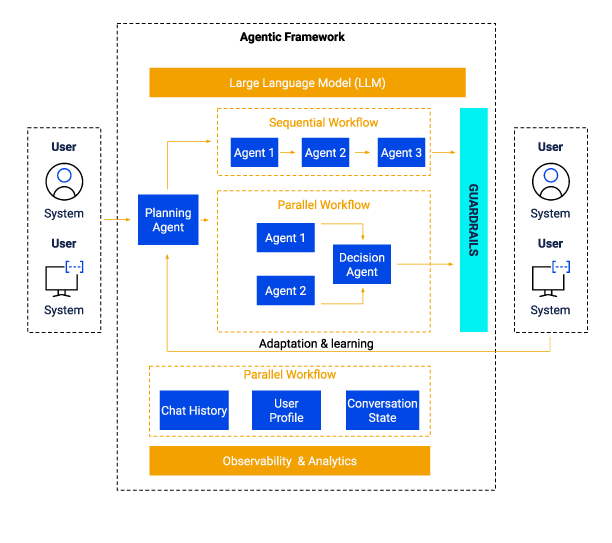
Agentic AI Sets A New Paradigm
Every major transformation in technology has replaced manual orchestration or tedious development with automation and simplification for wider adoption:
- Cloud abstracted the usage of physical infrastructure.
- REST simplified web application development.
- Agentic AI will now automate reasoning and execution.
Where cloud boosts or enhances deployment, Agentic AI boosts or enhances decision-making.
Where REST codifies user-application interaction through limited resources, Agentic AI understands user intent from natural language instructions.
For engineering leaders, the challenge and opportunity is to design architectures that allow AI Agents themselves to operate autonomously, in a scalable way, and can be easily assembled to enhance multiple tasks.

The Core of Agentic Architecture
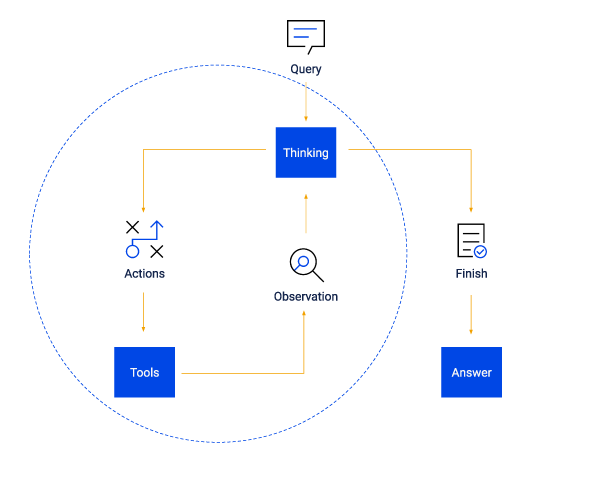
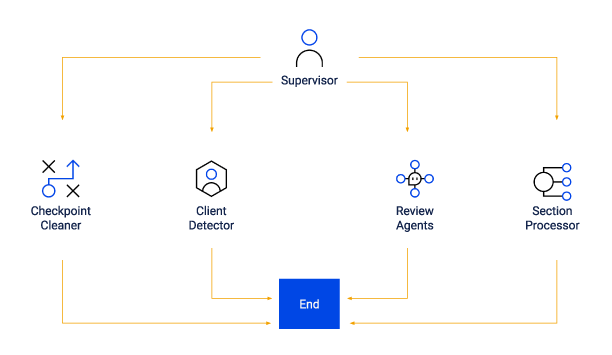
At its core, Agentic AI empowers LLMs to take actions. Although there are multiple design patterns, the most widely used involves an Orchestrator or supervisor in charge of interpreting and decomposing tasks. Optionally, this supervisor is capable of using tools (API's, MCP Servers, Python functions, etc.) evaluating outputs and reasoning from user feedback. Alternatively, subagents can serve the same purposes, depending on the use case.
This structure transforms static inference into a closed feedback loop, one that improves continuously as context and goals evolve.
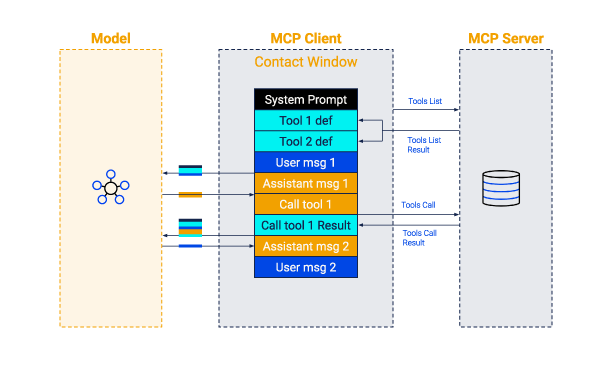
The Model Context Protocol: An Effort To Standardize Agentic Systems
Just as TCP/IP connected machines, the Model Context Protocol (MCP) connects models and tools. It defines how LLMs communicate with external APIs, databases, and compute environments, enabling interoperability and modularity. MCP is like a USB-C for AI systems: a shared connector that lets any model plug into an organization’s existing toolset.
MCP Enables:
- Interoperability: any model can access shared endpoints.
- Reusability: tools are defined once, reused everywhere.
- Maintainability: updates happen centrally, not per integration.
- Flexibility: models and vendors can be swapped without code rewrites.
This standardization is what allows agentic systems to move from custom experiments to a more flexible and repeatable deployment.
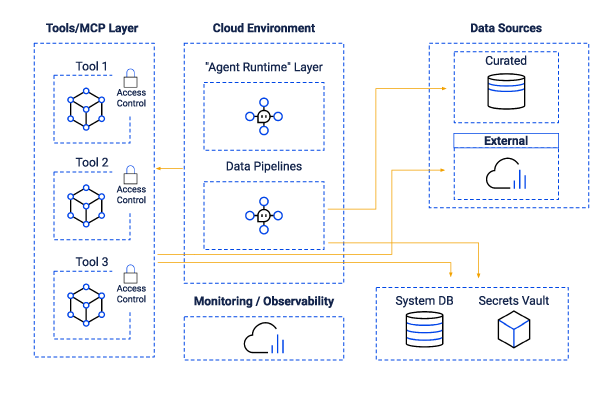
The MCP Gap: Same Tools, Different Actions
MCP is a powerful standard, but it isn’t perfect.One of its biggest limitations: different LLMs can hit the same MCP tool and take very different actions. MCP connects models to tools, but it doesn’t control how each model reasons about using them. That means the same prompt, routed through two different models, can result in two completely different sequences of actions. This happens because models vary in how they:
- Interpret intent
- Break down tasks
- Choose parameters
- Evaluate risk
- Decide when (or whether) to call a tool
MCP makes the interface consistent, not the behavior. Without validation and observability layers, enterprises face unpredictable agent behavior. One of the top blockers cited by CIOs for scaling autonomous AI (Gartner, 2024).
MCP doesn’t guarantee predictability, it increases interoperability.
If you swap out a model, your system’s behavior may change even though the tools and architecture stay the same.
That’s a control problem, not a protocol problem.
To keep MCP-based systems reliable, organizations need:
- Clear rules on which models and users can access which tools
- Observability for every action the agent takes
- Validation layers that catch incorrect or risky tool use
- Version tracking across models, prompts, and tools
Where This Is Heading
As MCP evolves, we’ll see more guardrails and behavior-normalization layers. Today, enterprises must design governance around the protocol. Don’t assume the protocol provides it.
When and Where Agentic AI Creates Value
Agentic AI works best where variability drives outcomes. Avoid fixing what isn’t broken, it’s okay to leverage other methods where deterministic logic already excels.
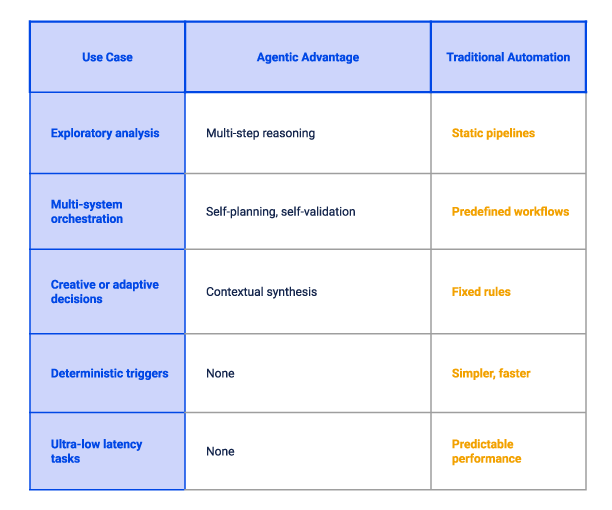
In short: use Agentic AI where malleability is an asset, not a liability.
Engineering the Agentic Stack
BCG finds enterprises underinvest in governance, resulting in impressive pilots that never clear security, risk, or compliance review.
Building reliable autonomy means thinking like an infrastructure architect:
- Context Layer: defines the shared memory across tools and agents.
- Action Layer: connects APIs, databases, and models through MCP.
- Evaluation Layer: verifies results and provides feedback loops.
- Observability & Governance Layer: manages access, performance, and trust.
Together, these layers form the Agentic Stack; the foundation for systems that can operate with independence but remain observable and auditable.
The Organizational Shift
Agentic AI hanges how organizations operate. The shift is from task execution to outcome ownership. Teams no longer decompose work into isolated tickets; they define goals and delegate execution to a combination of humans and autonomous agents, with shared accountability for results. Engineering is becoming the discipline of designing systems that reason, decide, and act, driven by objectives.
Leading the Transition
Adopting Agentic AI is about rethinking architecture and workflow. To start leading the transition within your organization:
Start Small, Think Systemically
- Identify workflows where goals are clear but execution is variable (uncharted).
- Pilot agentic systems that plan, act, and self-evaluate.
Design for Observability
- Build real-time dashboards for agent actions and results.
- Treat governance like infrastructure, not oversight.
Integrate, Don’t Isolate
- Connect agents through shared protocols (like MCP).
- Avoid siloed AI tools that fragment context and learning.|
Invest in Human-AI Collaboration
- Train teams to work with agents as partners, reviewers, testers, and co-decision-makers.
Engineering the Future of Autonomy
Agentic AI is a force multiplier. It’s how reasoning becomes reliable, reusable, and continuously improving.
Your competitors are already turning autonomy into velocity, and velocity into market advantage.
The enterprises that thrive will be those that design systems capable of learning, deciding, and acting at scale with safety, observability, and intent.
Factored has built and deployed agentic systems for Fortune 500 organizations, helping clients bypass the 12–18 month learning curve typical of autonomous AI programs and move directly into production execution (McKinsey; BCG benchmarks).