The homepage that was always a little late
Imagine opening a streaming app on a Sunday afternoon.
Last night, you watched a documentary. Two weeks ago, you binged a comedy series. For the last year, your profile has said something clear: you like slow-burn dramas, true crime, and stand-up specials.
But today is different. Your favorite team is playing in twenty minutes. You open the app and search for the team name. You watch a two-minute pre-game clip. You hover over the live event tile.
Then the homepage reloads and shows you… another crime documentary.
Nothing is technically broken. The model may be very good at predicting your long-term taste. The catalog metadata may be clean. The ranking model may have strong offline metrics. The API may even be fast.
The problem is simpler: the system did not understand that your current intent changed.
This is the real reason companies ask for real-time recommendations. They do not usually care about streaming architectures, feature stores, vector search, or low-latency APIs for their own sake. They care because stale recommendations feel wrong. In product terms, freshness is part of relevance.
But there is a trap here. Once “real-time personalization” becomes a goal, teams often assume everything should become real-time: every feature, every model, every catalog update, every scoring path. That usually makes the system more expensive, more fragile, and harder to debug without necessarily improving the user experience.
A better principle is:
Use real-time data only where freshness changes the decision.
That sentence is the foundation of a practical recommendation architecture.
What people usually mean when they say “real-time”
In client conversations, “real-time recommendation” is often a compressed way of describing several different product needs. If those needs are not separated early, the team can end up solving the wrong problem.
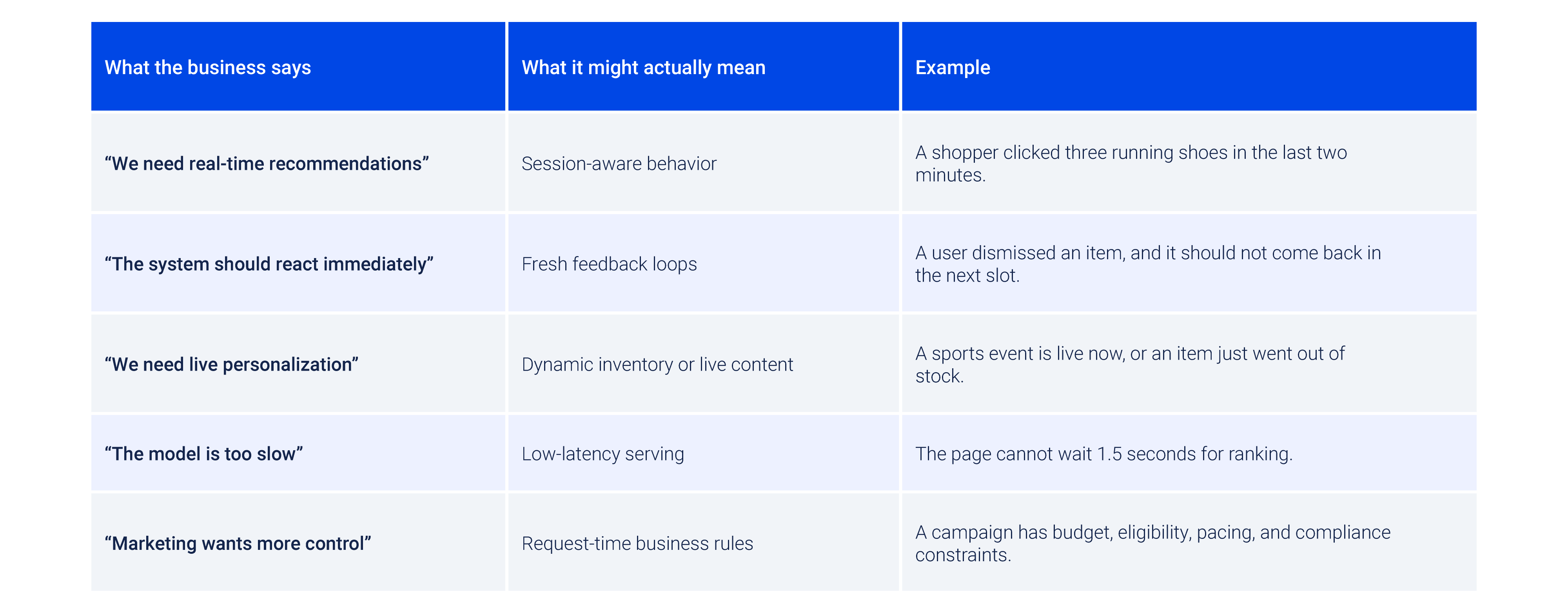
These are not the same requirement. A system can be low-latency without learning from the last click. It can learn from the last click without recomputing every user embedding on every request. It can support live inventory without making the entire training pipeline streaming.
The first design step is to translate “real-time” into a freshness question:
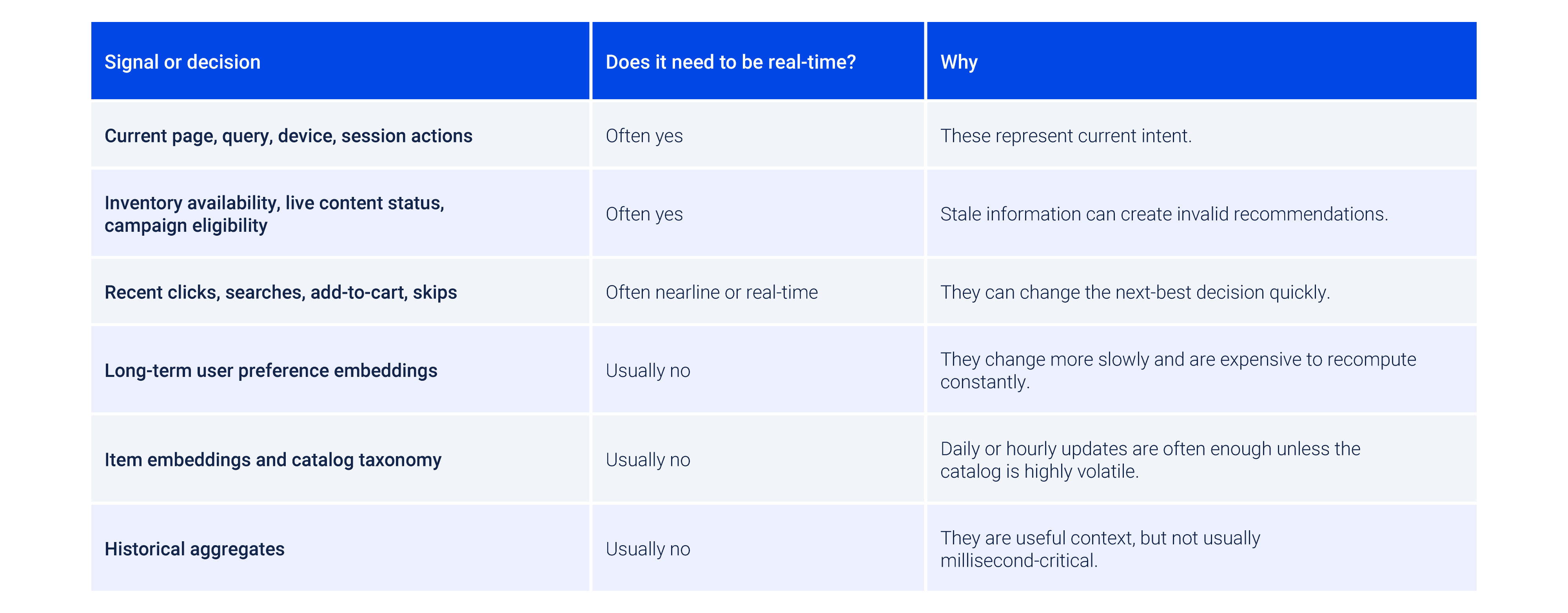
This is why the best systems are separated into tiers and are not exclusively batch or real-time.
The least-regret architecture: slow where possible, fast where necessary
A good recommendation platform treats freshness as a cost-benefit decision.
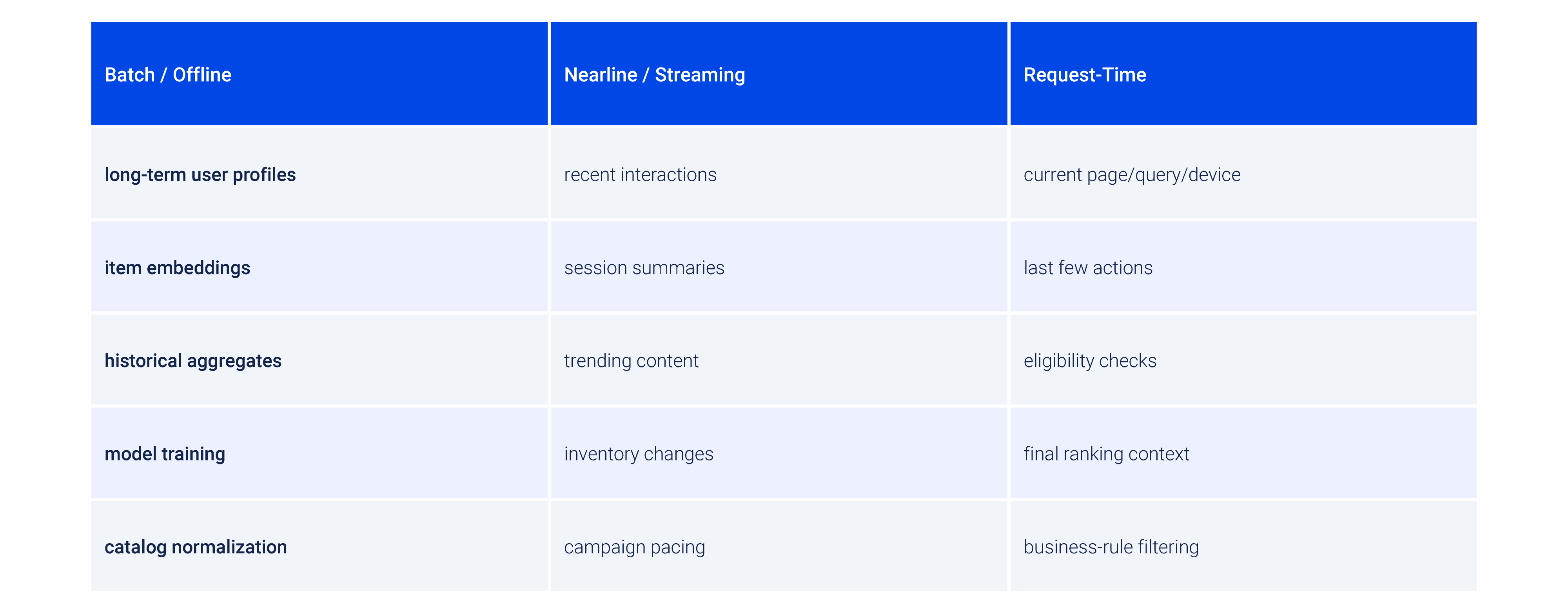
This design keeps the system honest. It forces the team to ask: what is the slowest freshness tier that still preserves decision quality?
That question saves money. It also saves complexity. Real-time pipelines introduce operational overhead: streaming jobs, exactly-once or at-least-once semantics, late events, online stores, cache invalidation, feature consistency, incident response, and harder debugging. If the business value is not clear, the architecture becomes technical debt with a modern name.
LinkedIn’s Concourse is a useful example of when freshness was worth the cost. LinkedIn’s older notification workflow ran as an offline Hadoop pipeline several times per day. The delay could be six to ten hours, which meant a member might receive a notification about content long after the conversation had already happened. LinkedIn rebuilt the workflow as a near-real-time distributed targeting and scoring platform because timeliness was directly tied to relevance and engagement.
An important question to ask here that helps deciding whether to use streaming or not is “does delay make the decision worse?”.
A retail example: the same person, two different sessions
Consider a retail site.
On Monday morning, a customer browses coffee machines. On Friday evening, the same customer browses baby strollers. If the recommendation system relies mostly on long-term profile features, it may keep showing espresso accessories because those are historically relevant. But the session is now telling a different story.
A session-aware system should react without forgetting the long-term profile. The user might still like premium products, certain brands, or a certain price range. But the candidate pool and ranking context should shift.
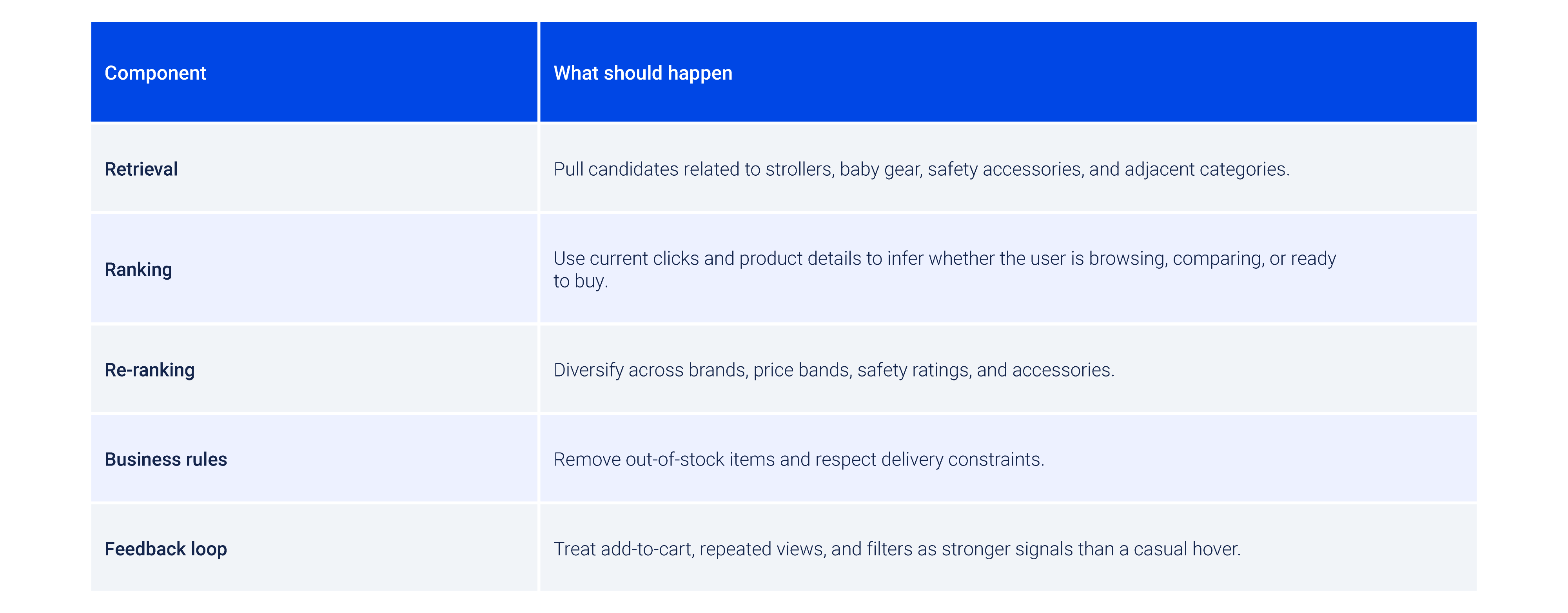
This is a common pattern across industries. In streaming, the equivalent is session mood. In ads, it is auction context. In food delivery, it is time of day and local availability. In dating apps, it can be recent engagement behavior and current session intent. In B2B SaaS, it might be whether the user is onboarding, stuck, expanding usage, or about to churn.
The user is a long-term profile plus a current situation, so it shouldn't be treated as a single static vector.
The common mistake: confusing freshness with intelligence
Teams sometimes assume that a fresher signal is always a better signal. That is not always true.
A user accidentally clicks a product. A child uses a parent’s streaming profile. Someone buys a gift for another person. A user doom-scrolls low-quality content for ten minutes and regrets it. A shopper looks at an expensive item out of curiosity, not intent.
Real-time signals are powerful because they are fresh. They are dangerous for the same reason.
A mature system needs safeguards:
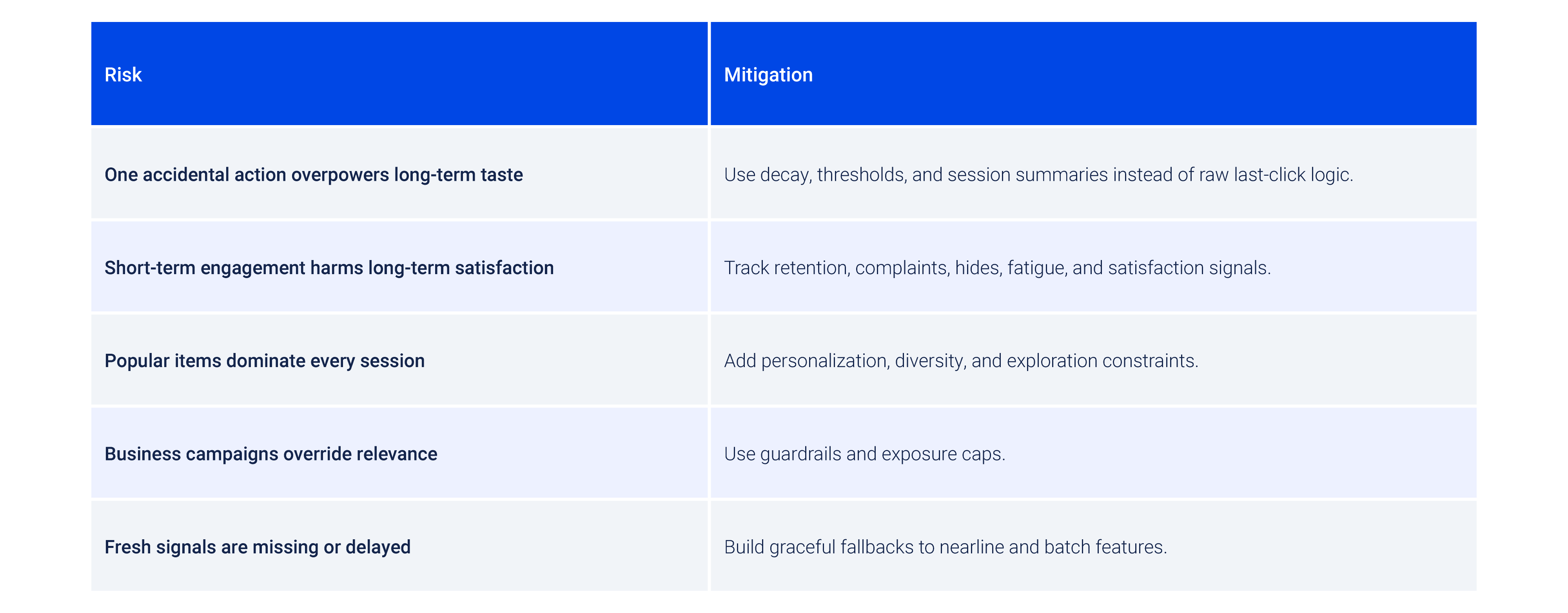
The goal is to use recency as one piece of evidence.
How to decide whether a use case needs real-time
A useful client workshop exercise is to score each use case against five questions.
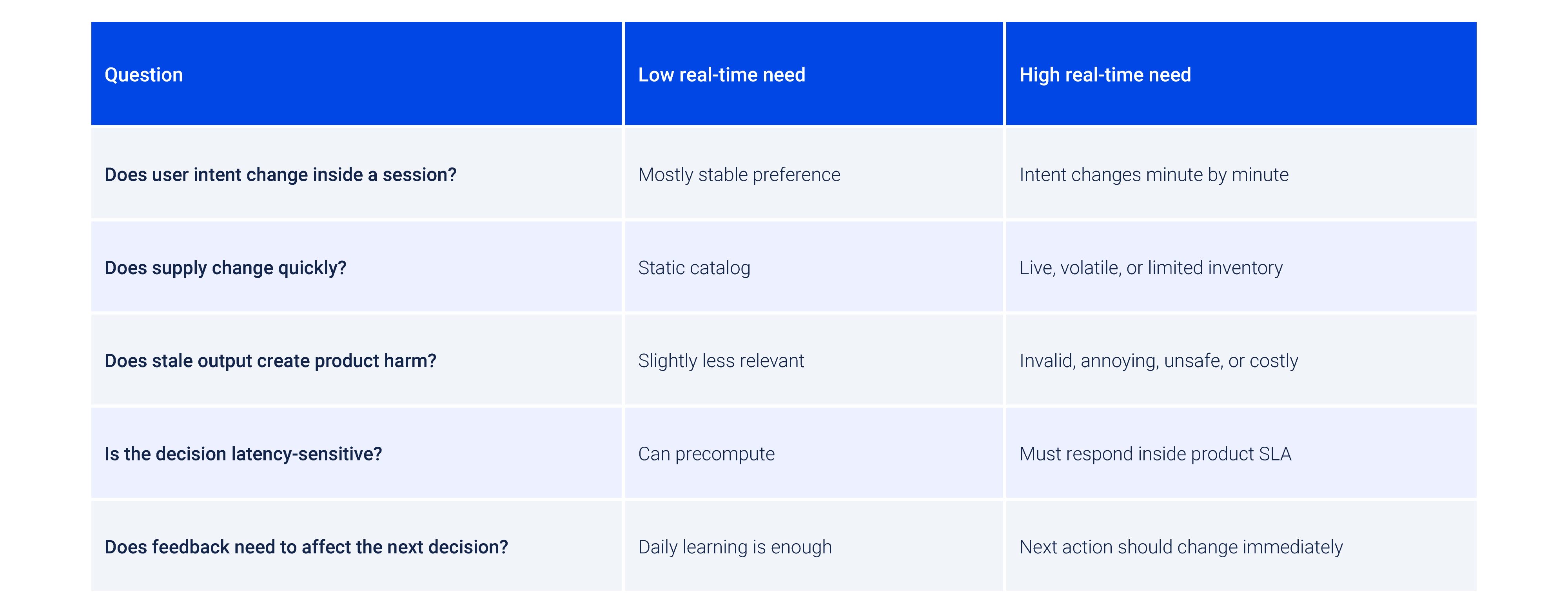
A homepage module may score high on session intent and latency but medium on supply volatility. A weekly email may score low on request-time serving but high on lifecycle timing. A notification system may score high on timeliness because a stale notification is worse than no notification.
This matrix helps avoid two bad outcomes: overbuilding real-time infrastructure for low-value surfaces, and underbuilding freshness for surfaces where stale decisions are visibly wrong.
What this means for architecture
Real-time recommendation is an operating capability with several layers:
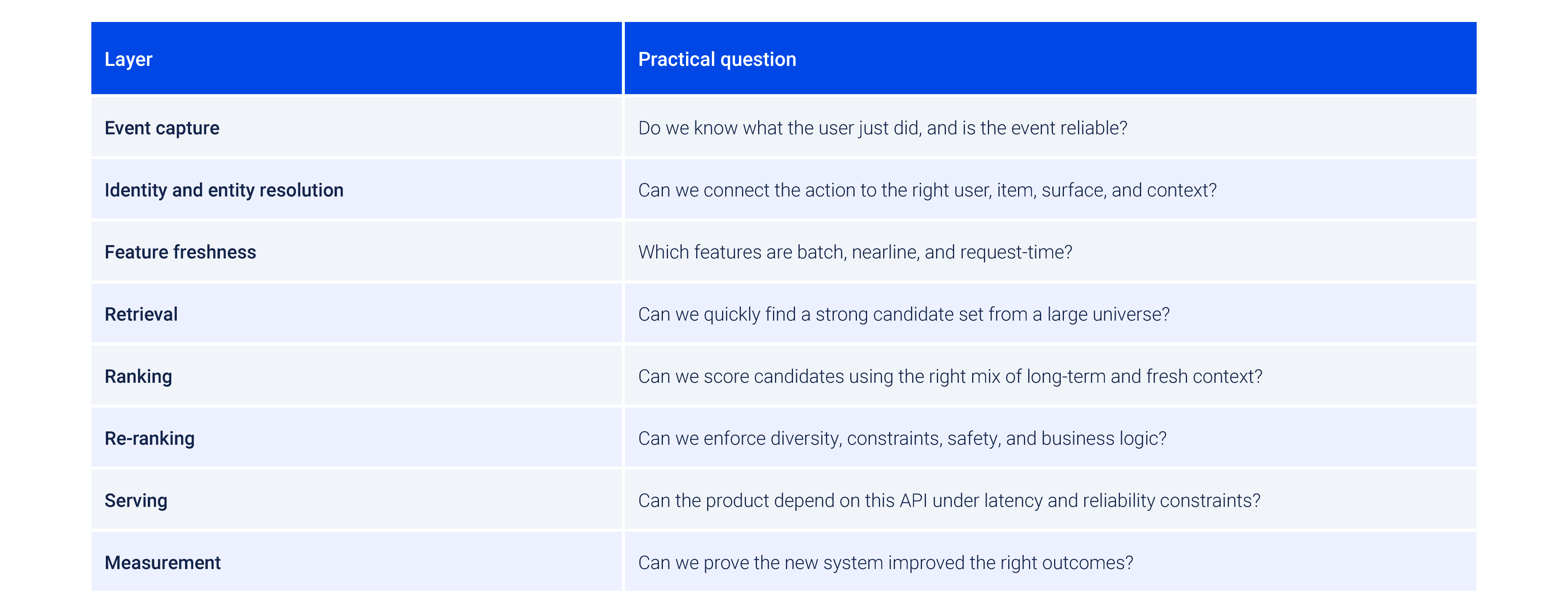
This is why recommendation initiatives fail when they are scoped as “build a model.” The model is one part of a decisioning system. In production, the gaps between layers usually create more pain than the layers themselves.
A better first engagement
For many clients, the right first step is to choose one high-value surface and map the freshness requirements.
A practical first engagement might produce:
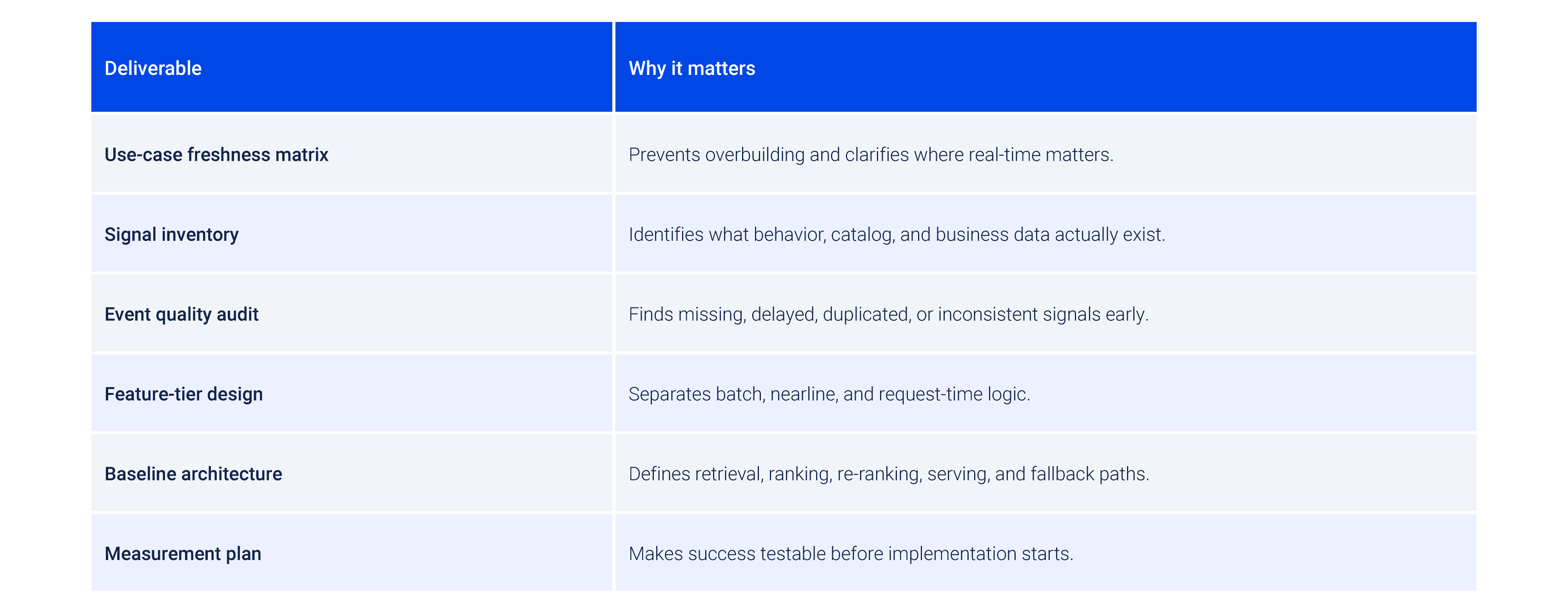
This is a stronger story than “we can build a recommender.” It says: we know where these systems break, and we know how to make them useful in production.
The Best Signal Depends on the Moment
Real-time personalization should not be sold as speed. Speed is only useful when it improves the decision.
The more precise promise is this:
A good recommendation system understands when yesterday’s behavior is still useful, when the last five minutes matter more, and when the safest answer is to slow down and use a simpler signal.
That is the difference between a model that predicts preferences and a product system that responds to people.
Explore the Full Series
This article is part of our four-part series on production recommendation systems. Continue with Part 2, Part 3, and Part 4.
Research references
- Google Developers — Recommendation systems overview (last updated 2025-08-25): https://developers.google.com/machine-learning/recommendation/overview/types
- Google Research — Deep Neural Networks for YouTube Recommendations: https://research.google/pubs/deep-neural-networks-for-youtube-recommendations/
- Meta Engineering — Scaling the Instagram Explore recommendations system: https://engineering.fb.com/2023/08/09/ml-applications/scaling-instagram-explore-recommendations-system/
- LinkedIn Engineering — Concourse: Generating Personalized Content Notifications in Near-Real-Time: https://engineering.linkedin.com/content/engineering/en-us/blog/2018/05/concourse--generating-personalized-content-notifications-in-near
- arXiv — Counterfactually Evaluating Explanations in Recommender Systems: https://arxiv.org/abs/2203.01310
- arXiv — Offline Recommender System Evaluation under Unobserved Confounding: https://arxiv.org/abs/2309.04222
- arXiv — Demystifying Sequential Recommendations: Counterfactual Explanations via Genetic Algorithms: https://arxiv.org/abs/2508.03606
- arXiv — FedFlex: Federated Learning for Diverse Netflix Recommendations: https://arxiv.org/abs/2507.21115