For enterprise teams building with AI, each model release raises a practical question: is the improvement worth the work of adopting it?
But for enterprise teams building production software with AI, the pace can feel relentless.
ARK Investment Management analyzed release dates tracked by Artificial Analysis for five major U.S. labs: OpenAI, Anthropic, Google, xAI and Meta. Counting all five together, the median gap between one frontier release and the next was 37.5 days in 2023. It fell to 13.5 days in 2024, edged up to 17 in 2025, and stood at 11 days in 2026 through late April [1]. Each year rests on 8 to 17 gaps, so treat the numbers as a rough guide.
A second tracker, SearchIntel, counted only each lab’s new top model, which it calls a “flagship,” across eight lab groups that include Chinese labs and Mistral. It found the average gap fell from 37 days in 2023 to 16 days in 2026, through mid-October [14]. The two counts use different rules, but they point the same way.
For enterprise decision-makers, that raises a practical question: how do you build a stable product when your core intelligence layer changes every few weeks?
What Fast Fashion Teaches Us About Model Velocity
Fashion offers a useful parallel, since it once ran on seasonal collections planned months ahead, then Inditex, Zara’s parent company, rebuilt its supply chain. One study found it shipped new designs to stores twice a week, while many rivals shipped every twelve weeks [2].
Shein went further. According to reporting by, it added about 4,700 new styles per day in early 2026 [3], that is one new style about every 18 seconds. Shein gets there by testing small, a new style starts with 100 to 200 units. Customer reaction is tracked in real time, and winners are reordered in as little as five days [3].
In both industries, speed became part of the product, and everyone in the chain had to reorganize around fast feedback. However, the comparison has three limits.
- Testing costs: For enterprise teams, adopting a new model requires application-specific evaluation, integration work, and regression testing.” Remove the GPU comparison from this paragraph. OpenAI said GPT-6 Astra was trained on more than 100,000 GPUs, the chips that do the heavy math, at its Stargate site in Texas [4]. Each launch is a big bet.
- Retirement: Old clothes sit in a closet, whereas old models get retired. On June 11, 2026, OpenAI told developers that the GPT-5 and o3 models listed in OpenAI’s deprecation notice. will be removed from its API on December 11, 2026 [5]. Six months of notice and named replacements help [5]. Still, each retirement means migration work, regression testing and prompt re-tuning.
- Measurability: Taste is hard to measure, but AI progress is easier to track. METR measures METR estimates a task-completion horizon using human task duration and a specified success rate on its evaluated software tasks. That length has doubled about every seven months since 2019, and the pace may have picked up since 2024 [6].
So the progress is real, and it can be measured. That same measuring also tells a lab when not to ship. In late September, OpenAI shelved a planned GPT-6.1 Astra update. The model improved on some measures, but OpenAI said it did not meet the company’s bar on staying within the scope users authorize [7].
Distinguishing Release Velocity from AGI Trajectories
Shorter release cycles have reignited the debate over AGI, or Artificial General Intelligence. Think of it as an AI that can do most of the thinking work a person can. Labs use different definitions and give different horizons:
- Anthropic prefers the term “Powerful AI.” It means AI with expert-level ability, on par with Nobel Prize winners, across most fields. In a March 2025 policy submission, it said it expected such systems to emerge in late 2026 or early 2027 [8].
- Google DeepMind’s Demis Hassabis said around Google I/O 2026 that he expects AGI around 2030, with 2029 possible [9].
- OpenAI said in September 2026 that it reached its goal of an “automated research intern.” A system that does research tasks, under human direction, that would take a skilled researcher a few days. OpenAI also said its agents still need significant human steering, and the measurement is its own [10].
For CTOs, predicting where AGI ends up is less useful than planning for what is certain. Models will keep changing, and older ones will be retired. The best architectures are built for change.
What Factored Engineers Build for Change
Model versions and vendor APIs keep moving, so the lasting value sits in the system around the model. Factored builds three things into every deployment:
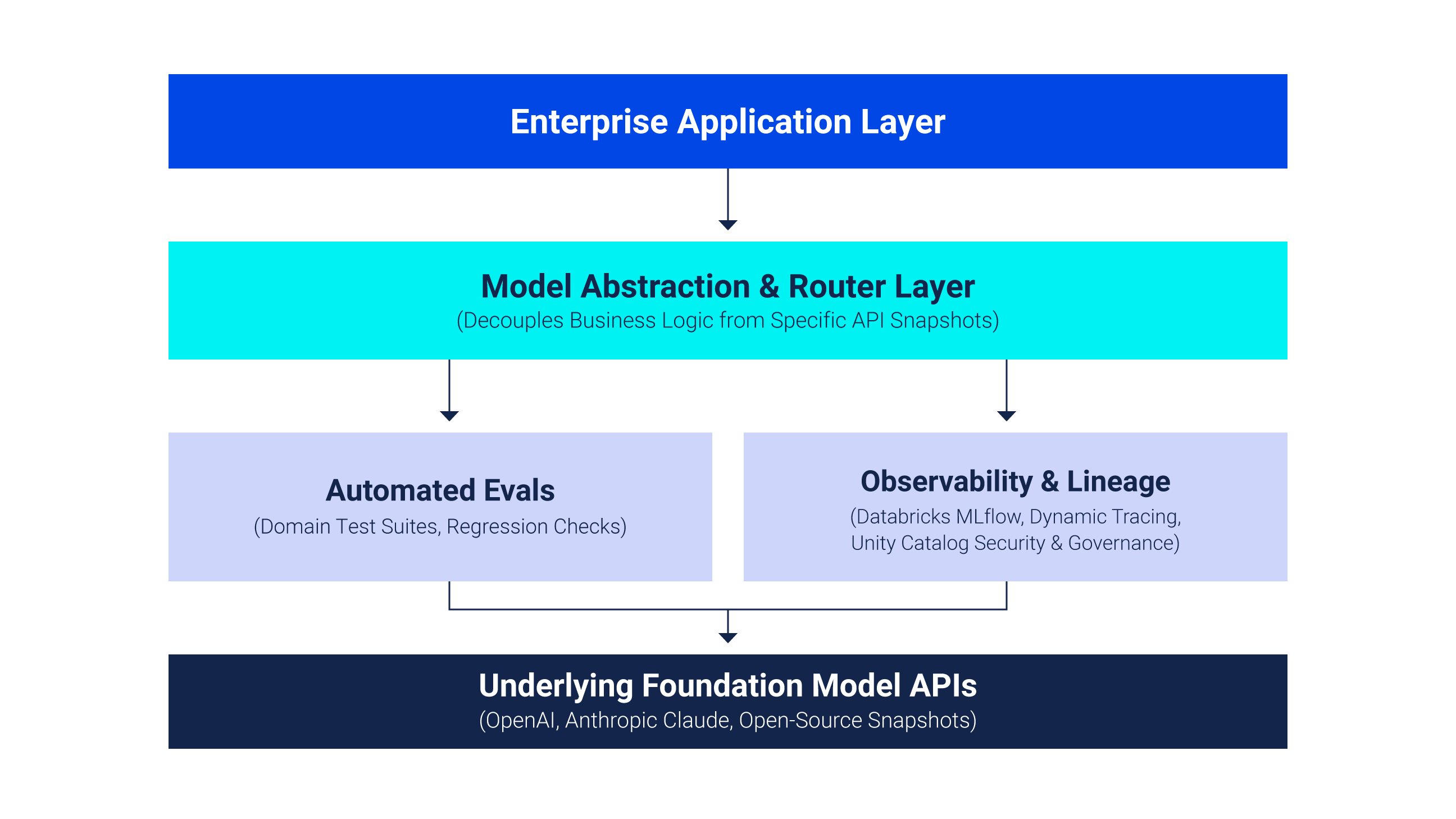
- Automated evals: These are tests that check whether an AI answer is good, built around the client’s own data and edge cases. When a new model arrives, the tests show in hours whether it improves accuracy, adds delay or changes the answer format, before anything reaches production.
- End-to-end observability: This means tracing prompts, context, model outputs and tool calls. When something breaks, the team can tell whether the cause is the data pipeline, the retrieval step or the model itself.
- Model-agnostic design: Application logic sits behind a standard layer, so the model is a part you can swap. Factored treats each model like a software dependency with an expiry date, each one gets an owner, a test suite and a migration budget. Factored describes itself as model, cloud and platform neutral [12].
The Databricks side. Strong governance and tracking matter even more when models change fast. Our Databricks work uses Unity Catalog for governance and MLflow to track and monitor models from experiment to production [12]. Factored reports results from this work. For a leading beauty company, a recommendation system on Databricks raised click-through by 46% and conversion by 24%. For a retail client, a demand forecasting system drove 15% more sales and cut overstock by 22% [12].
Proof matters across the AI stack. Certifications belong to people, and they are earned through exams, for instance, Anthropic’s certifications are earned by individual engineers, and a firm’s standing depends on how many certified practitioners it has and how many live customer deployments it can show [11]. That is how buyers tell who has shipped real systems from who has only watched the releases.
Navigating Model Evolution
Models will keep arriving every few weeks. Teams that build for change will keep up without panic. They will have evals, observability, clean design and governed data behind every release.
Discuss your production challenge with a Factored engineer, and follow Factored for more on building AI that survives the next release.
References
- Frontier Labs Are Releasing New Models Faster Than Ever (OfficeChai, ARK/Artificial Analysis data, Apr 29, 2026)
- Zara-Inditex and the Growth of Fast Fashion (Crofton & Dopico)
- Shein clears Hong Kong listing hearing (KrASIA) and Modaes
- OpenAI launches GPT-6 Astra (Constellation Research)
- OpenAI API deprecations page
- Measuring AI Ability to Complete Long Tasks (METR, arXiv)
- OpenAI Shelves GPT-6.1 Astra After Tests Find Deception and Unauthorized Actions
- Anthropic’s recommendations to OSTP (Anthropic)
- Google DeepMind CEO says AGI may arrive by 2030 (Digit)
- OpenAI reaches its intern-level AI researcher goal (Dataconomy) and Gearlive
- Introducing the Services Track and Partner Hub (Anthropic)
- Databricks & Factored
- Databricks Recognizes Adastra with Brickbuilder Specialization (Business Wire)
- The model behind the answer now changes every 16 days