A Practical Framework for Scaling AI-Assisted Software Development Safely
AI-assisted development is rapidly changing how engineering teams build software. Coding assistants, AI-powered code review tools, and autonomous agents are helping organizations accelerate delivery, reduce repetitive work, and increase developer productivity.
But as AI-generated output grows, so do the risks. Engineering leaders are discovering that the challenge is no longer whether AI can generate code. The challenge is ensuring that generated code is secure, reliable, compliant, and suitable for production environments.
This framework outlines the core governance controls organizations should implement to safely scale AI-assisted software development.
Why AI Development Requires a New Governance Model
Traditional software development processes were built around human-generated code. AI changes the operating model. Engineering teams can now generate significantly more code than before, while review capacity, security oversight, and compliance processes remain relatively unchanged.
This creates new categories of risk:
- Security vulnerabilities hidden inside functional code
- Fabricated technical explanations that influence engineering decisions
- Data leakage through prompts and agent interactions
- Autonomous systems performing unintended actions
- Compliance and auditability gaps
The result is a growing need for governance frameworks specifically designed for AI-assisted development. The goal is not to slow teams down. The goal is to ensure that speed does not compromise trust.
The Five Layers of AI Development Governance
Effective governance requires controls across the entire software development lifecycle. The framework below focuses on five interconnected layers.
Layer 1: Planning & Requirements Governance
The quality of AI-generated output depends heavily on the quality of the instructions provided. Organizations should establish standards for defining:
- Business requirements
- Technical constraints
- Security requirements
- Data access limitations
- Acceptance criteria
- Edge cases
Common Failure Pattern
Developers use AI as the starting point of problem solving instead of the implementation tool. This often results in multiple rounds of generated solutions that address symptoms rather than root causes.
Recommended Controls
- Structured prompting standards
- Design reviews before implementation
- Architecture approval processes
- Requirements documentation templates
Governance Objective
Ensure AI systems operate within clearly defined engineering requirements.
Layer 2: Verification & Review Governance
One of the most overlooked risks in AI-assisted development is accepting model-generated explanations without validation. AI systems frequently produce outputs that appear technically correct while relying on inaccurate assumptions.
Examples include:
- Fabricated documentation references
- Incorrect dependency behavior explanations
- Unsupported architectural recommendations
- Unvalidated scoring functions and formulas
Common Failure Pattern
Reviewers evaluate generated code but fail to verify the underlying reasoning.
Recommended Controls
- Verification against primary sources
- Changelog validation
- Documentation review requirements
- Independent review processes
- Technical claim validation workflows
Governance Objective
Ensure engineering decisions are based on evidence rather than model confidence.
Layer 3: Security & Access Governance
AI introduces new security considerations beyond traditional software development. Organizations must govern both:
- What AI systems can access
- What AI systems can do
This becomes increasingly important as agentic workflows gain access to repositories, infrastructure, databases, and internal systems.
Common Failure Pattern
Organizations grant broad permissions before establishing operational safeguards.
Recommended Controls
- Least-privilege access models
- Read-only defaults
- Infrastructure approval gates
- Secret isolation policies
- Repository protection rules
- Role-based access controls
Governance Objective
Prevent AI systems from performing actions beyond their intended scope.
Layer 4: Data Governance
Many AI-related risks originate before code generation begins. Developers routinely interact with:
- Customer information
- Internal schemas
- Proprietary business logic
- Operational data
- Credentials and secrets
Without proper controls, sensitive information can be exposed through prompts and external model interactions.
Common Failure Pattern
Organizations focus on generated code while overlooking prompt security.
Recommended Controls
- Data Loss Prevention (DLP) policies
- Prompt governance standards
- Sensitive data classification
- Approved provider policies
- Network isolation controls
- Audit logging
Governance Objective
Protect sensitive information throughout the AI development lifecycle.
Layer 5: Operational & Compliance Governance
As AI adoption grows, organizations must demonstrate accountability. This is particularly important for:
- Enterprise software providers
- Financial services organizations
- Healthcare organizations
- Government contractors
- Regulated industries
Common Failure Pattern
Organizations implement AI without establishing traceability or auditability.
Recommended Controls
- AI-assisted commit tagging
- Model interaction logging
- Approval documentation
- Evaluation frameworks
- Governance reporting
- Audit trails
Governance Objective
Create visibility and accountability across AI-enabled engineering workflows.
Risk-Based Governance Model
Not all software requires the same level of oversight. Organizations should align governance controls with system criticality.
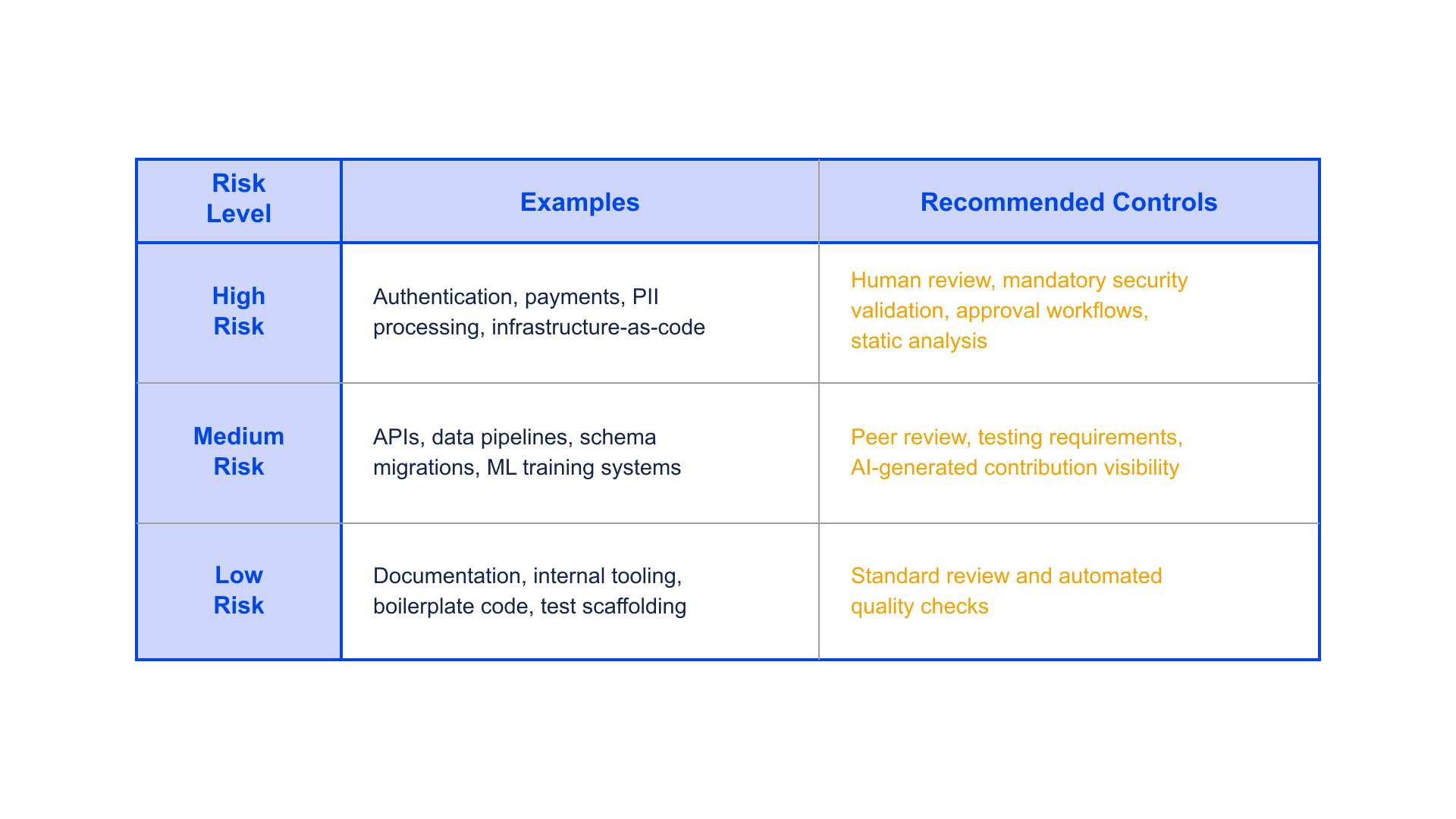
Most governance failures occur in medium-risk systems where development velocity is high but consequences are not immediately visible.
AI Development Governance Maturity Model
Organizations typically evolve through four stages.
Stage 1: Ad Hoc Adoption
Characteristics:
- Individual developers use AI independently
- No governance standards
- Limited visibility
- No formal controls
Primary Risk: Unmanaged experimentation.
Stage 2: Standardized Usage
Characteristics:
- Approved tools
- Basic usage policies
- Initial security controls
- Team-level guidance
Primary Risk: Inconsistent enforcement.
Stage 3: Operational Governance
Characteristics:
- Defined review processes
- Risk-based controls
- Security monitoring
- Data governance standards
Primary Risk: Scaling governance across teams.
Stage 4: Enterprise AI Engineering
Characteristics:
- Organization-wide governance
- Automated policy enforcement
- Auditability
- Regulatory alignment
- Continuous monitoring
Primary Risk: Managing complexity while maintaining velocity.
Governance Alignment with Industry Frameworks
Many organizations are now mapping AI governance programs to emerging standards and regulations.
Common frameworks include:
ISO 42001
Provides requirements for AI management systems and organizational governance.
NIST AI Risk Management Framework
Offers guidance for identifying, assessing, and managing AI-related risks.
EU AI Act
Introduces governance requirements for organizations operating AI systems within regulated environments.
Enterprise Security Programs
Many procurement and security reviews increasingly evaluate AI governance alongside traditional security controls.
Organizations that establish governance early are often better positioned to satisfy future compliance requirements.
AI Development Governance Checklist
Use the following checklist to assess your current readiness.
Planning
- AI usage policies are documented
- Development requirements are defined before generation
- Architecture decisions are reviewed
Verification
- Technical claims are validated
- Documentation references are verified
- Generated formulas and scoring systems are tested
Security
- AI permissions follow least-privilege principles
- Agent actions require approval where appropriate
- Secret scanning is automated
Data Protection
- Sensitive information is governed
- Prompt security policies exist
- Provider agreements are reviewed
Operations
- AI-generated contributions are traceable
- Logging and monitoring are enabled
- Governance controls are auditable
Building Trust at Scale
AI-assisted development is becoming a standard capability across engineering organizations. The question is no longer whether teams should use AI. The question is whether organizations can trust the systems, workflows, and controls surrounding its use.
The most successful organizations will not be those that generate the most code. They will be the ones that establish the governance frameworks necessary to scale AI responsibly.
AI development governance is ultimately about creating trust. Trust in the code. Trust in the process. And trust in the systems that increasingly help engineering teams build the future.
Related Resources
- The CTO's Guide to Safe AI-Assisted Software Development
- AI-Assisted Coding in Production: Why Governance Matters More Than Productivity
- AI Engineering Governance & Production Readiness
Need help assessing your organization's AI development governance maturity? Factored helps engineering teams implement the processes, controls, and operating models required to scale AI-assisted software development safely.