Generation scales. Validation is hard.
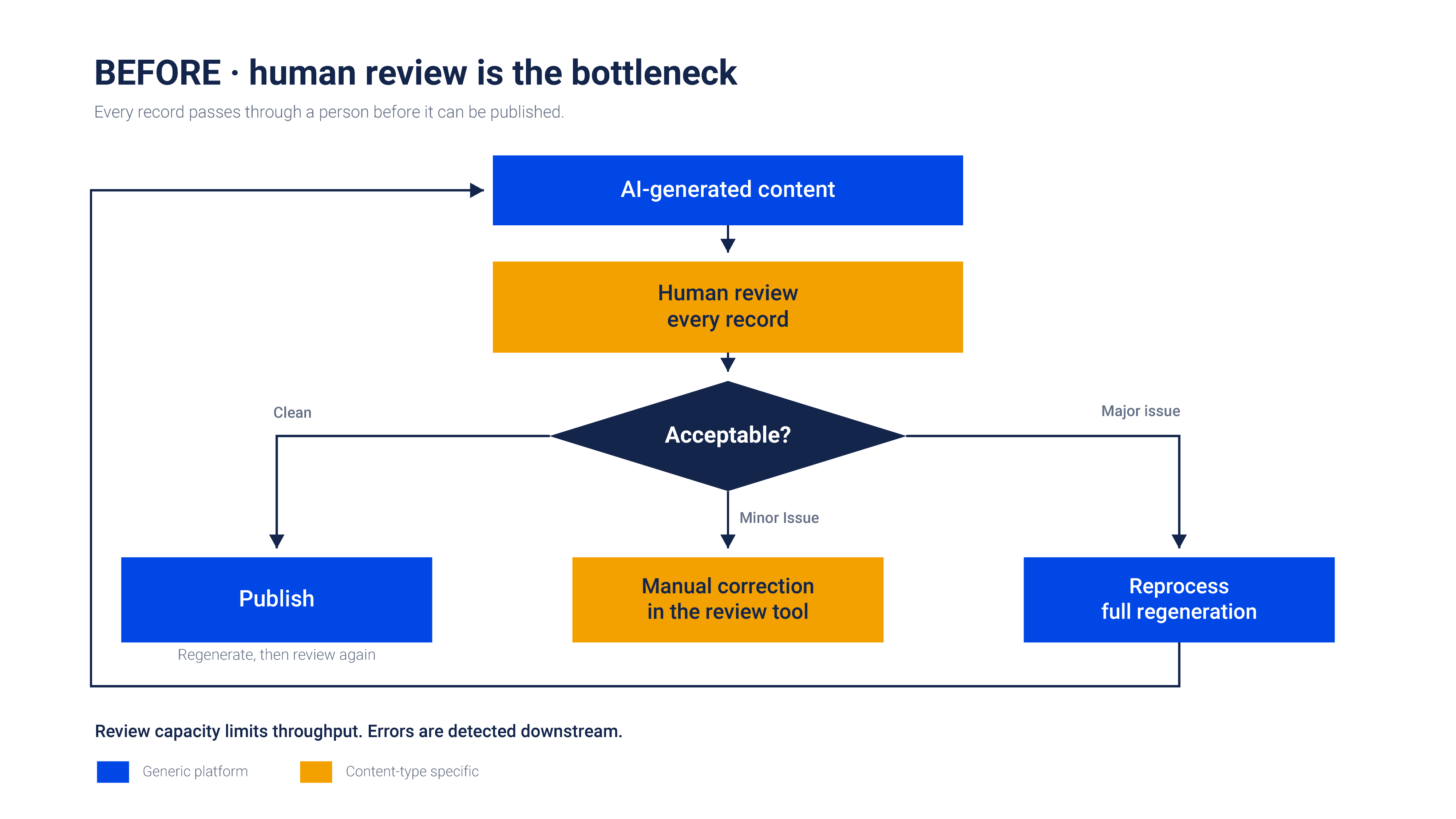
It is becoming more straightforward to put a GenAI system into production and generate a large amount of content. However, a key consideration is deciding what is safe to publish, especially if your GenAI application generates sensitive content or has stricter quality requirements, like an exact level of fidelity, where even minor changes in wording, symbols, numbers, or order may be considered unacceptable by the end user with minimal response time. If every output still has to be reviewed by a person, the review queue becomes the bottleneck.
In this scenario, the reviewer is primarily looking for the kinds of mistakes that are easy for a model to make and expensive to miss: a name or figure changed, a number rendered incorrectly, a section dropped, or information that was never in the source.
When the reviewer finds one large or several small problems, the output can be sent back for reprocessing or fixed manually. This works, but it makes quality assurance depend on a human finding the problem first. As the volume of AI-generated content grows, that approach does not scale with it.
What such a workflow needs is a second line of defense: an automated evaluator that can review every generated artifact before it is published to the end user, identify likely problems, and provide enough structure for the consuming application to decide what to do next. This is what we can call LLM-as-a-Judge: using an LLM to evaluate another system's output against a defined set of criteria, rather than simply generating content itself.
This kind of content-quality workflow is a natural first production use case, but the underlying pattern is broader. The problem shows up in translation, summarization, customer support, document generation, and other systems that produce text without a pre-existing reliable reference and need to meet a high bar for quality and precision while keeping a low response time.
Evaluating without a reference answer
Reference-based evaluation is straightforward when a trustworthy reference exists: compare a generated translation with the approved translation, or a generated answer with a known answer and so on. In many production systems, that reference does not exist when the decision has to be made. Often a corrected version only exists after a human finds a problem, so it cannot be the thing that decides whether the original output should be published, since that approach is hard to scale.
That changes the question put to the evaluator. Instead of asking, "Is this exactly correct?", it asks, "What evidence is there that this output is wrong?" The answer comachinemes from the generated artifact, the context available to the evaluator, and, when useful, other -generated intermediate outputs that can be compared for consistency.
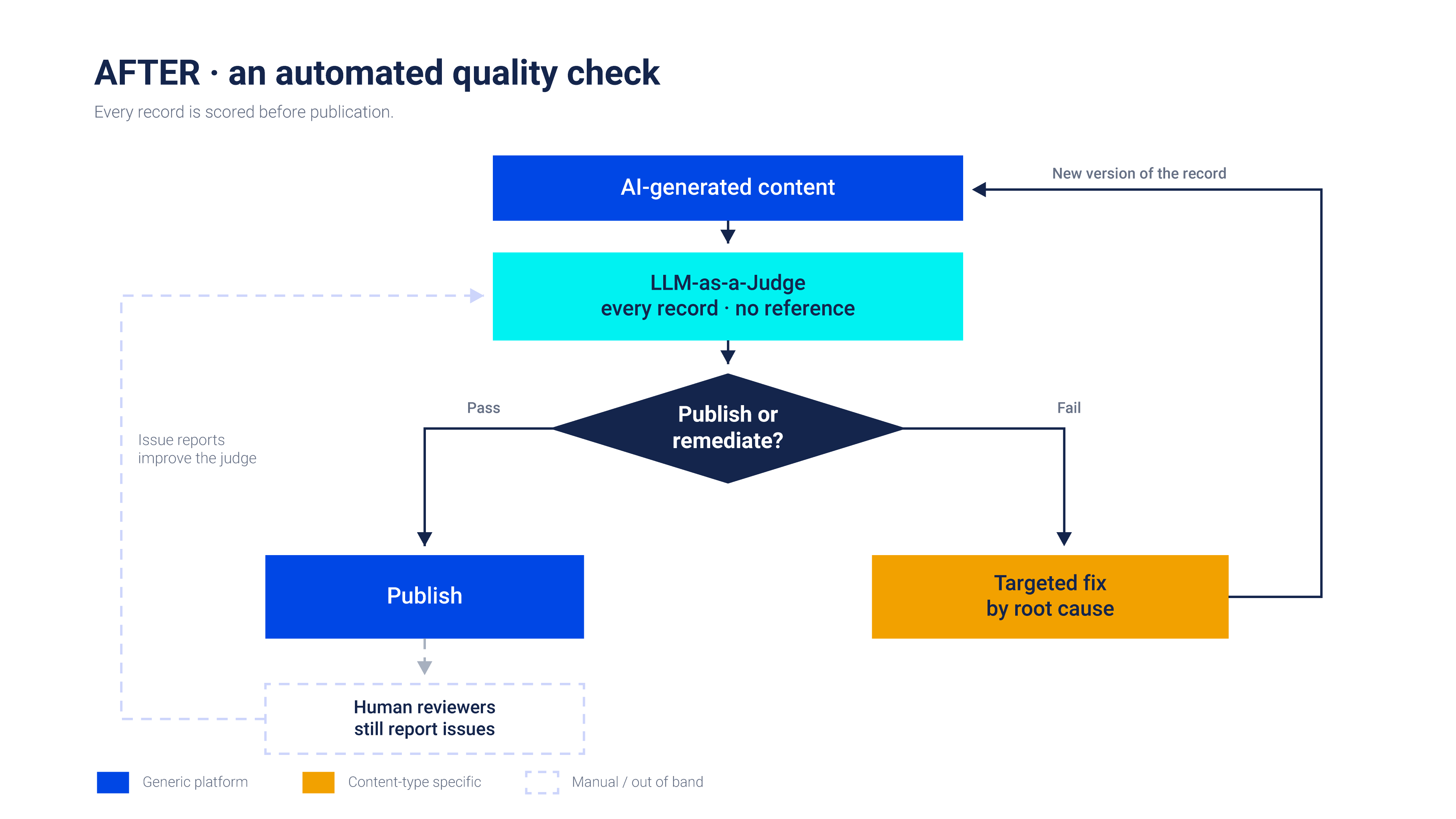
The judge draws on three main sources of evidence:
A Calibrated Scoring Framework
Each quality dimension has explicit scoring criteria: what to measure, what to penalize, and what to ignore. That last part matters. Some content types carry acceptable irregularities such as informal phrasing, verbatim speech patterns, or domain shorthand; treating every one of them as an error would make the judge noisy enough to become useless.
Cross-pass Consistency
Earlier machine-generated intermediate outputs or reasonings in a multi-stage system can provide additional context. The judge can look for disagreements between rounds, but those are not treated as ground truth. They are evidence about consistency, not a source of correctness.
Evidence Inside the Artifact
The output can also contain its own warning signs. A response can refer to a question that is not present, start in the middle of a sentence, or otherwise show signs of truncation or missing context. These signals are especially useful when multiple upstream rounds share the same mistake.
There is a trade-off here. Reference-free evaluation removes the cost of collecting a corrected answer for every case, but it puts more weight on the scoring framework and on how the evaluator is calibrated. It also cannot always reliably detect an error that is shared by every source available to the judge.
Quality dimensions that generalize well
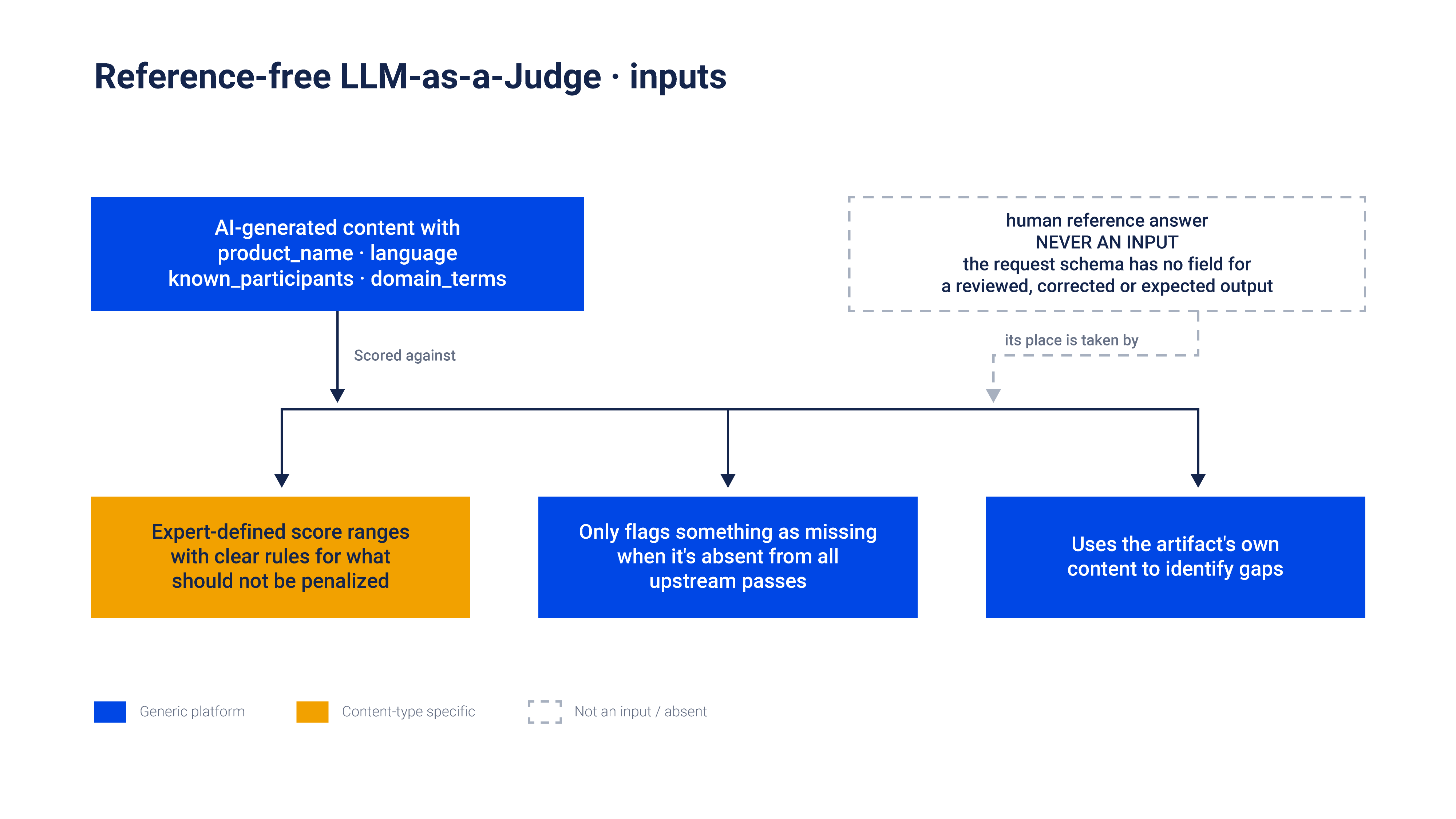
A possible implementation centers on a handful of quality dimensions that generalize well across text-generation workloads, for example, faithfulness (does the output preserve the source?), groundedness (does it stay within the supporting evidence?), consistency (does it hold together?), and fluency (is it well-written?). The specific set is chosen and named per project; these are common, reusable starting points, and the set can be extended with additional dimensions for specific use cases as needed.
Faithfulness
Did the generated artifact preserve the information that should be there? Depending on the application, that includes missing content, altered names or numbers, dropped or truncated sections, and other omissions.
Groundedness
Does the output stay within what the available evidence supports? This translates particularly well to RAG and other grounded applications, where the judge can look for claims that cannot be supported by the supplied context.
Consistency
Does the output make sense on its own? Does the meaning flow, and does the artifact avoid contradicting itself? This dimension is largely intrinsic, so it does not depend on having a reference answer.
Fluency
Is the writing clear enough for the intended use? The dimension itself is generic, but the scoring is not. Informal or conversational content needs to tolerate patterns that would be errors in a formal report, so the threshold has to follow the application.
The important architectural choice is not the exact four dimensions. It is the contract around them: each scorer returns the same structured shape, scores use the same direction, and scoring dimensions do not depend on one another. That makes it possible to add or replace dimensions without changing the serving interface.
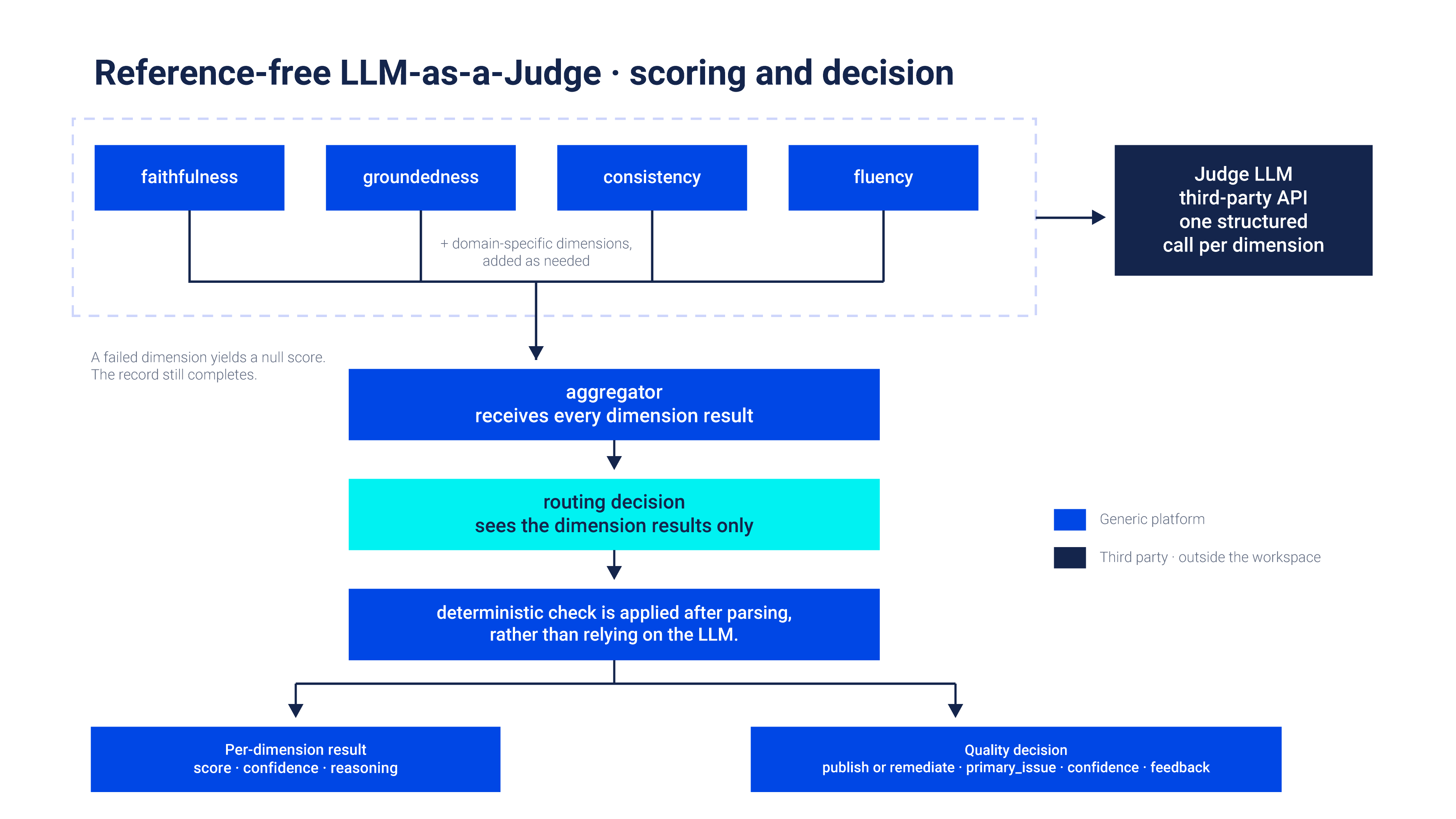
One practical lesson from implementing this pattern is that straightforward decision logic is better handled as a post-execution hook than delegated to the model. The model should focus on evaluating the content, explaining its reasoning, identifying potential issues, and providing the outputs and reasoning the application needs to make the final decision.
Validate the Judge, not just the content
There are two separate evaluation problems in an LLM-as-a-Judge system. The first is the production task: evaluate a generated artifact. The second is meta-evaluation: determine whether the judge itself makes useful decisions. Treating those as the same problem is an easy way to build something that looks impressive but is difficult to trust.
For the production task, requiring a reviewed output before publishing is undesirable (though reviewed outputs can be used for offline evaluation). For judge validation, labels are useful. Labeled sets can be built from human reports and paired with a control set of records that had not been flagged, then used to measure how well the judge recalls known issues and how often it flags clean records.
Synthetic noise injection is a complementary way to test the judge. By deliberately introducing specific errors into otherwise valid content, one can create controlled test cases where the expected outcome is already known. This verifies not only that the judge catches the issue, but that it identifies the right problem for the right reason. For example, removing or altering a known piece of information and then checking whether the corresponding evaluation dimension flags it. In practice, this works like a small synthetic evaluation dataset: known defects are introduced, the judge is run, and its output is compared with the issues intentionally introduced.
Each evaluation dimension can be wrapped as an MLflow scorer, so you can run the judge offline against an evaluation dataset and inspect it via MLflow. Scored against labeled data as MLflow scorers, the judge reports pass or fail per dimension per record, and the column pass rates show where it is strong and where it needs tuning.
This yields two useful things: the scorer itself, which defines how each dimension is evaluated, and the evaluation results, which show how the judge performs across labeled examples. In production serving, the same evaluation logic is called directly as part of the judge workflow.
Each judged record is traced as well: a parent span per record, a child span per dimension, and a single structured output, so any production decision can be traced back to its evidence.
Treating the Judge as a Production Model
The judge is not just a prompt that produces a score. It is a production AI component, so it should follow the same MLOps lifecycle as any other deployed model. The version of the judge that runs in production should carry the exact evaluation logic it was tested with, rather than relying on configuration or prompts that can change independently of the deployed artifact.
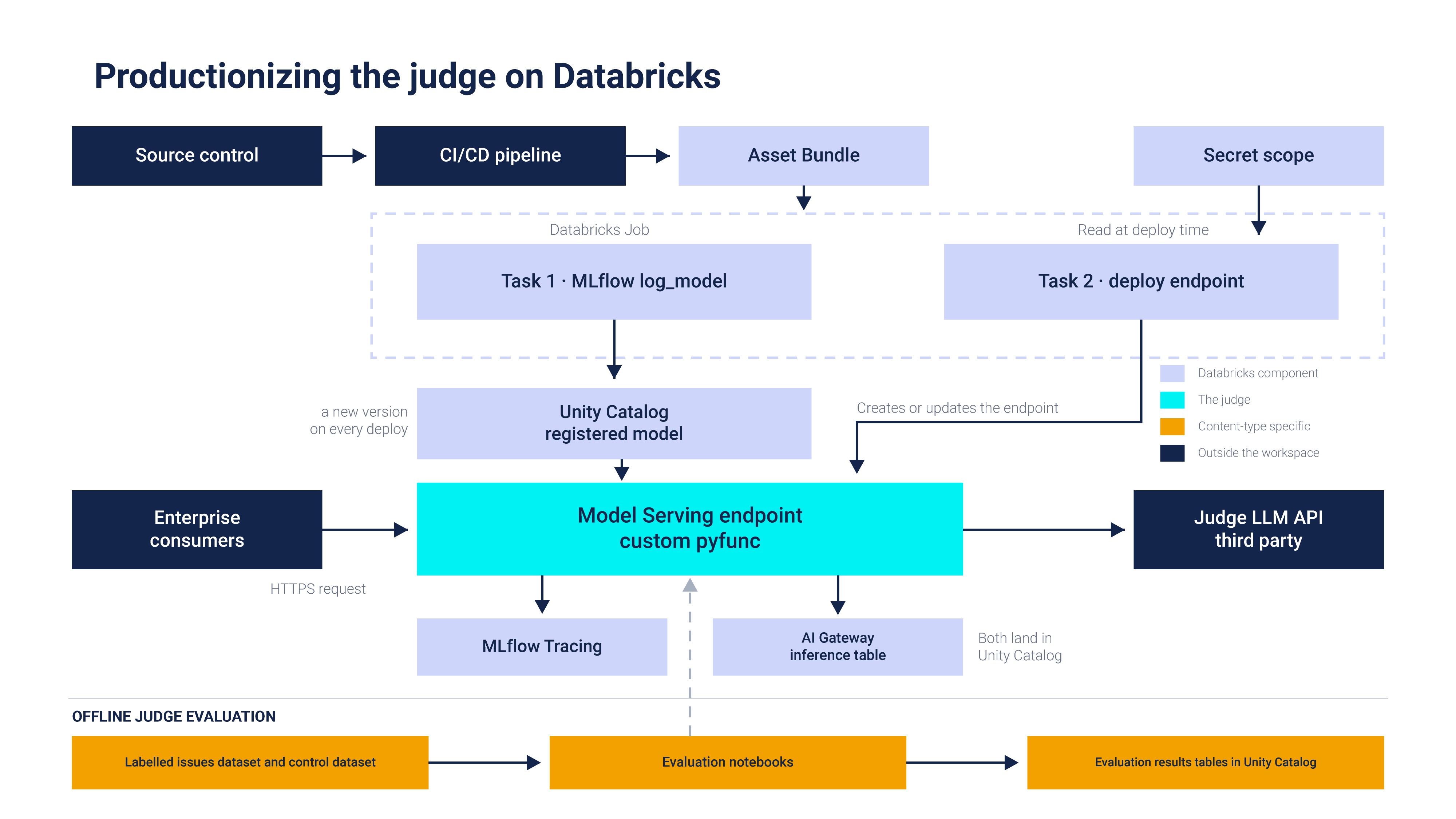
In practice, this means packaging the judge and its evaluation logic together, registering and versioning it, governing those versions, and deploying them through a repeatable process. The production architecture is built around that lifecycle: source-controlled code moves through CI/CD, deployment resources are defined declaratively, a job registers and deploys a new judge version, and the resulting model is served through a governed endpoint. This gives a clear path to test changes, promote new versions, and roll back when necessary, while keeping the scoring behavior tied to the model version being served.
DABs, Jobs, and CI/CD: Make the Deployment repeatable
The production setup separates the judge's code, model artifact, and deployment resources into a repeatable workflow. Changes start in source control and go through CI/CD before being deployed to Databricks. Declarative Automation Bundle defines the resources and configuration for the deployment, while a Lakeflow job handles the deployment steps, including registering the new judge version and updating the serving endpoint. The resulting model is governed in Unity Catalog and exposed through Model Serving, giving a clear path from a code change to a versioned, deployable judge.
MLflow: Package the Judge with its Evaluation Logic
The judge is packaged as an MLflow pyfunc model. Its input and output signature becomes the contract, and the evaluation files are tracked with the model artifact. That means a served version carries the exact scoring logic it was evaluated with. Changes to the evaluation criteria are therefore treated like a model change and go through deployment rather than being edited behind the endpoint.
Unity Catalog: Governance and Version Control
Unity Catalog provides the governed model name and retains previous versions. The endpoint can be pinned to a specific version, providing the platform with a clear rollback target.
Databricks Model Serving: Expose the Judge as a Service
The deployed model is orchestration code that invokes a judge model for each dimension. That turns the evaluator into a service other applications can call instead of tying the logic to one Databricks notebook or pipeline. Access is controlled through the serving endpoint, and the request contract stays independent of the application that produced the content.
Tracing and Gateway: Make Decisions Inspectable
Each judge call is traced and tagged by record and dimension, so a single production output can be followed back to the underlying evaluations. AI Gateway inference tables can capture requests and responses in governed tables as well. Because those tables contain the evaluated content, retention and content-reduction policies matter as much as the capture itself.
The platform uses the judge evaluation as part of the deployment workflow. The evaluation dataset is versioned, judge evaluations are tracked in MLflow, and new judge versions are compared against the current production version before promotion. Operational metrics such as judge failure rate, auto-publish rate, reprocessing rate, latency, and cost can be exposed as well, giving visibility into both quality and production behavior via a Databricks AI/BI Dashboard.
From a Score to a Control Loop
A judge that only produces a score is useful for reporting. A judge that produces a structured output can also become part of the production application loop.
The pattern is simple: evaluate the AI-generated artifact, make a quality decision, and let the consuming application decide how to respond. In one application, a failing output can trigger another generation round. A RAG application could choose to retrieve more evidence. A summarization system might regenerate with stricter instructions. The judge does not need to know how the application fixes the problem.
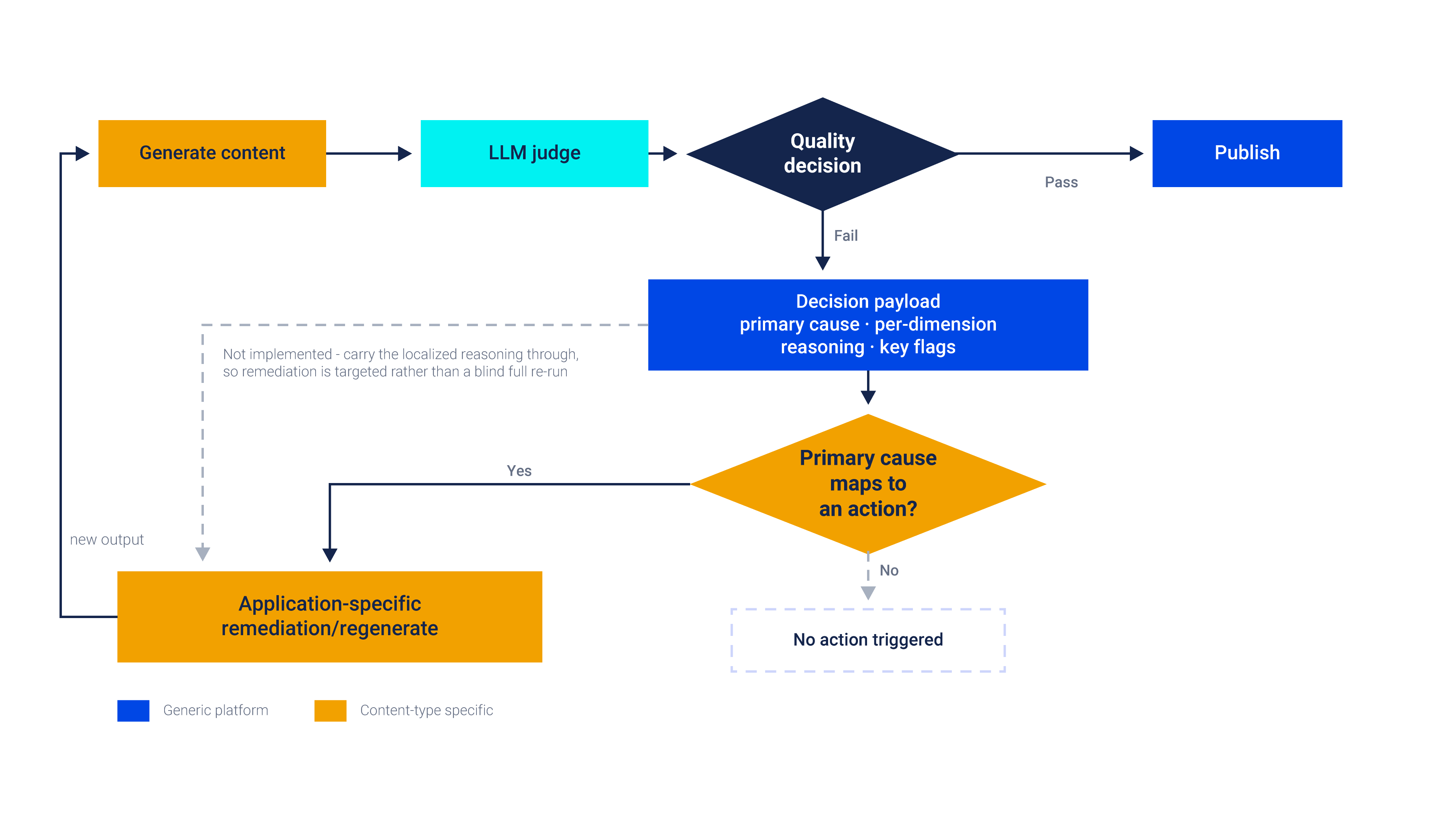
This separation of concerns is important. The generic component owns detection and diagnosis. The application owns decision-making based on the judge output.
The feedback loop can be fully integrated into the workflow. When the judge identifies an issue, the relevant feedback is passed back to the generator so the next attempt can address the specific problem. The workflow also limits retries and can escalate cases for human review when repeated attempts do not resolve the issue.
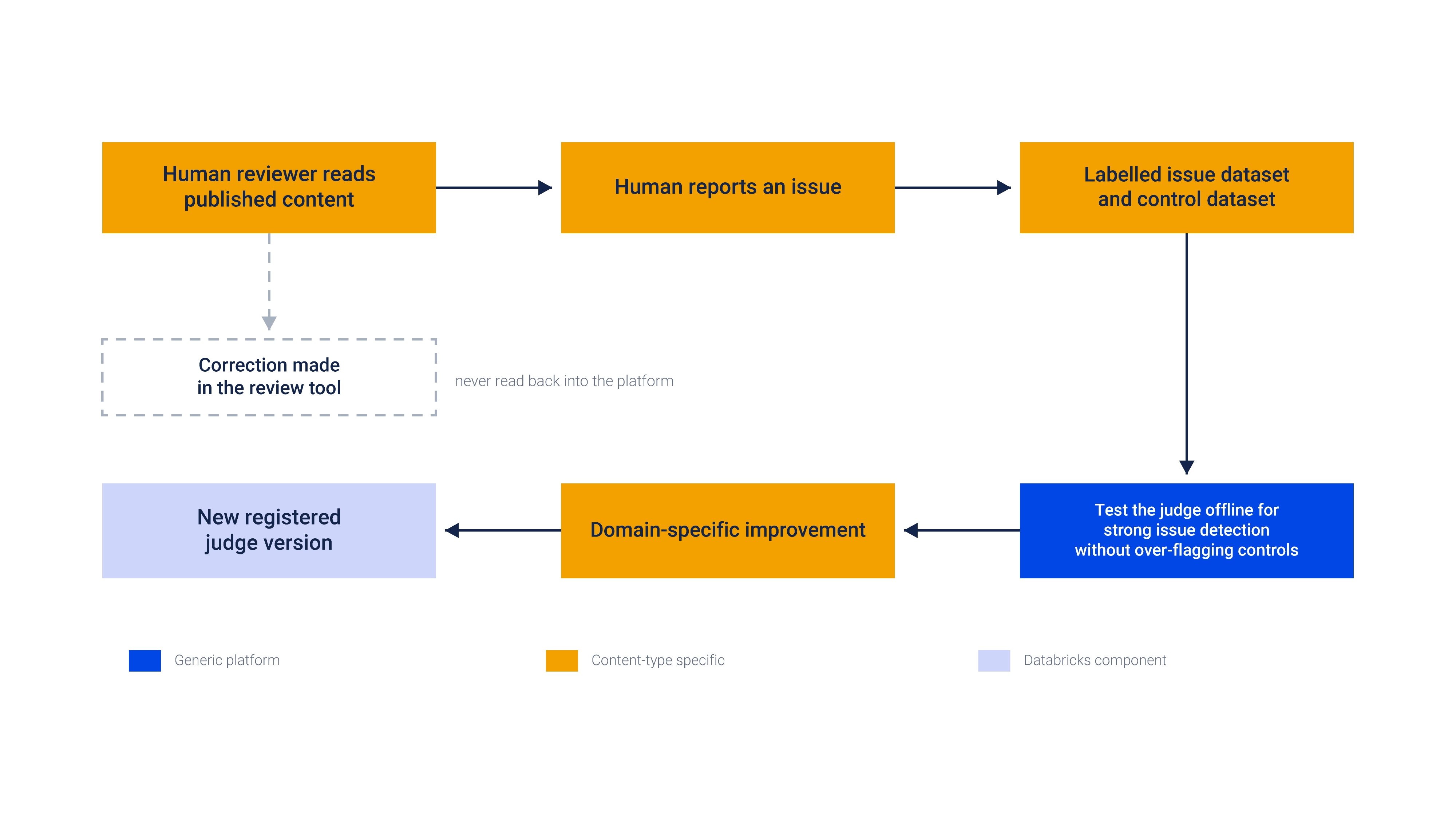
There is a second, slower feedback loop as well. When human reviewers identify issues that the judge missed, those cases are added to the evaluation dataset and used to improve the judge over time. The corrected output can be treated as production ground truth and, together with the identified issue, provides additional evidence for refining the evaluation criteria and scores and for validating future judge versions - a continuous improvement loop.
What changed operationally
The most important result is not a judge score. It is what happens to the review workflow after the score exists.
In one production deployment, reprocessing requests dropped by more than half. Because each full review takes a person considerable time, the quality gate eliminates the majority of manual reprocessing cycles and saves a substantial share of the reviewer-hours those reviews would otherwise require. Over time, eliminating the large majority of these cycles avoids most of the reviewer-hours previously spent on this intervention.
A reprocessing request is a human action: someone had to find the problem and ask for the record to be regenerated. Catching the issue before publication removes that manual step, shortens the path to the end user, and improves the SLA.
The impact comes from how the quality gate is tuned. Issues that affect the accuracy or meaning of the output can block publication and trigger reprocessing, while minor or cosmetic issues do not automatically create another processing cycle. This avoids simply replacing the human-review bottleneck with a new queue of false positives from the judge.
What Generalizes Across Applications
The reusable part of the platform is the judging contract, not any single application's logic. The same request layer, orchestration, decision structure, serving interface, deployment chain, and tracing pattern can be reused by another AI application.
What changes is the quality model around it: the scoring, the relevant dimensions, the issue taxonomy, the context fields, and the remediation action. For translation, summarization, RAG, support replies, document generation, or generated reports, dimensions like faithfulness, groundedness, consistency, and fluency are useful starting points. Other workloads may need additional dimensions, such as coverage for a summary or citation correctness for a RAG answer. The platform should treat the dimension set as a configurable contract rather than static.
That is also why this is best thought of as a platform rather than a single-application feature. The judge provides a common quality contract; each application decides what "good" means for its own content and what to do when the content fails.
The Broader Lesson
Production AI needs more than a generator. It needs a way to decide, consistently and at scale, whether the generated result is good enough to use.
Databricks provides a practical way to treat that evaluator as a production AI asset: evaluate it, package it with its scoring logic, register and govern versions, expose it through Model Serving, deploy it with DABs, and trace the decisions it makes.
The same lifecycle can be used to evaluate and improve the judge itself, so changes to the model or evaluation criteria can be tested before they reach production. The goal is to maintain one reusable quality layer that can sit in front of different AI applications, while allowing each application to decide how to respond when the judge identifies a problem.