
Standardizing Enterprise Metrics to Accelerate Executive Decision-Making
Business Problem
For a rapidly scaling staff augmentation leader, the lack of a "single source of truth" created significant operational friction.
Disparate metric definitions across Sales, Finance, and Operations meant that key KPIs, such as "Annual Recurring Revenue", varied depending on the department reporting them.
This misalignment forced leadership to spend critical time reconciling conflicting data rather than executing on strategic growth initiatives.
Technical Challenge
While a "Gold Layer" of cleaned data was in place, the organization’s logic remained decentralized. Individual teams were applying custom filters and calculations directly within BI tools or ad-hoc SQL queries.
This fragmentation meant that data consistency could not be enforced at the warehouse level, making it impossible to ensure that the same metric would return the same value across different platforms or AI agents.
Without centralized metric governance, the same KPI could return different outputs across dashboards, spreadsheets, and emerging AI interfaces. For an organization scaling its data and AI capabilities, that inconsistency became a strategic risk.
The Factored Solution
Factored engineered a dbt Semantic Layer built on a foundation of rigorous dimensional modeling to centralize logic upstream.
By moving calculation definitions out of the visualization layer and into a governed code base, we created a single "metric API." This architecture ensures that any interface, whether a BI dashboard, an Excel spreadsheet, or a generative AI agent, queries the exact same logic, effectively decoupling the business definitions from the data consumption tools.
Whether users accessed data through executive dashboards, spreadsheets, operational reporting, or generative AI agents, every query referenced the exact same business logic.
Outcomes
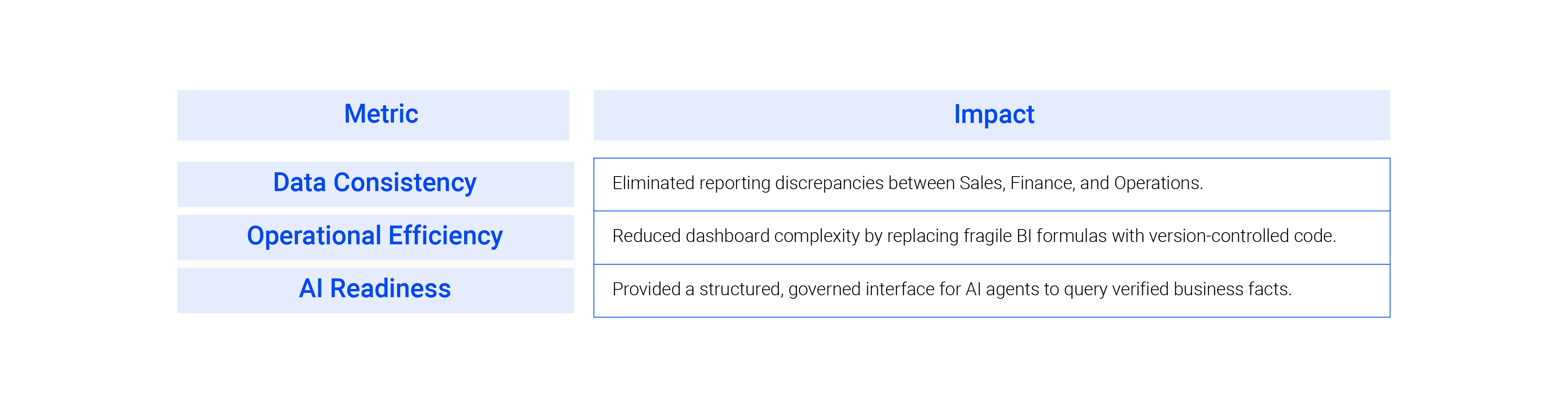
Strategic Value
This initiative transformed the data platform from a passive repository into a strategic asset. By centralizing the "brain" of the data stack, the organization reduced the "trust deficit" in their reporting.
For leadership, this translates to faster decision cycles and a robust foundation for reliable AI integration, ensuring that automated insights are factually aligned with enterprise-wide standards.
Key Takeaway
A Semantic Layer is the essential bridge between raw data and reliable AI; without governed definitions, LLMs and analytics tools aren't providing insights, —they are simply guessing at your business logic.