In primary research and institutional investment, consultation transcripts serve as legal and analytical records. Equity analysts evaluating private equity buyouts and healthcare strategists reviewing clinical trial benchmarks depend on accurate transcription. An incorrect financial figure, a misidentified pharmaceutical compound, or a statement attributed to the wrong speaker can change the substance of a consultation.
For a leading global expert network, reliable transcription at scale is an operational requirement. Third-party vendors imposed high costs for complex, non-English audio, slow turnaround times, and limited language coverage.
Off-the-shelf Automatic Speech Recognition (ASR) tools could not bridge the gap. Zero-shot models exhibited high error rates on niche terminology, struggled with multi-speaker attribution in dense dialogues, and lacked the domain-specific vocabulary injection needed for context-specific sectors such as tech, retail, automotive, institutional finance, and medicine, among others.
To eliminate multi-vendor dependencies and scale output without expanding overhead, Factored architected and deployed an end-to-end, two-tier platform on Databricks. The platform combines an in-house, multi-model ASR pipeline with dynamic glossary injection, a multi-agent LLM-as-a-judge quality gate, and a text-level remediation loop.
Production Bottlenecks: Acoustic Drift and the Ground-Truth Deficit
Automating enterprise transcription exposes two operational failure modes:
- Acoustic Drift on Domain Terms: Deploying baseline models internally introduces acoustic drift. Open-source speech models consistently fail on specialized vocabulary, including clinical compounds, company names, and regulatory acronyms.
- The Ground-Truth Deficit at Runtime: While automated transcription significantly reduces processing time, validating the output at runtime presents a structural challenge. Unlike Retrieval-Augmented Generation (RAG) systems, where model outputs can be checked against an indexed vector database, speech-to-text operates without an immediate ground-truth document.
To prevent errors from reaching institutional clients, human reviewers listened to raw audio while checking transcripts line by line. Reviewing a 60-minute consultation could take an hour or more, sometimes exceeding two hours when extensive corrections and rewrites were required, making manual quality assurance costly and difficult to scale with demand.
Phase 1: Building Modular Multi-Model ASR on Databricks
The engineering team spent two quarters benchmarking, fine-tuning, and hyperparameter tuning models, followed by one quarter deploying the production platform natively on Databricks.
The architecture minimizes vendor lock-in through modular, interchangeable components for speech recognition and speaker diarization, supported by an acoustic preprocessing framework:
- Audio Chunking and Dynamic Glossary Injection: Consultation audio is partitioned into 2-minute segments. The ingestion engine matches consultation metadata (industry vertical, practice area, and client glossaries) to dynamically inject specialized terminology into the decoding context, stabilizing phonetic alignment on specialized terms.
- The platform supports multilingual consultations at scale, with a 170% increase in language coverage.
- Validated Delivery Accuracy: Accuracy is calculated on polished, deliverable-grade transcripts using standardized reference metrics against human-reviewed baselines:
Word - level Accuracy = 100 ( 1 - WER) forword - basedlanguages
Character-level
Accuracy = 100 (1 - CER) forcharacter - basedlanguages ( Japanese,Mandarin)
Delivered accuracy improved by 9 percentage points in continuous production.
Phase 2: Building Multi-Agent Evaluation with Databricks AI Gateway
To eliminate full-transcript manual audits, Factored deployed a multi-agent quality gate powered by large language models through Databricks AI Gateway.
A central coordinator directs four specialized sub-agents running in parallel, rather than relying on a single, undifferentiated audit prompt. Each sub-agent assesses transcripts using one-shot rubrics. The team developed and refined these rubrics through repeated evaluations using historical defect and ground-truth datasets, along with judge meta-evaluation, until the evaluations established a satisfactory accuracy baseline.
- Hallucination & Fabrication Agent: Detects fabricated numbers, unauthorized dates, and contextual distortions.
- Missing Content Agent: Identifies conversational drop-offs, abrupt syntax cuts, and dropped introductory or concluding passages.
- Diarization Integrity Agent: Flags cross-talk misattributions to verify that assertions are assigned to the correct participant.
- Language & Domain Quality Agent: Audits technical syntax and verifies compliance with domain-specific vocabulary.
Calibration During Test Monitoring/Phase And Evaluation
To mitigate the risk of false-positive evaluation loops, the multi-agent system was initially evaluated in a non-blocking calibration phase.
The judge evaluated transcripts in parallel with human auditors over two-week sprint cycles, writing scores, classifications, and rationales to a Databricks Delta table without blocking downstream delivery. A meta-evaluation pipeline monitored two criteria:
- Classification Parity: Ensuring the model's defect taxonomy aligned with human auditor tags.
- Reasoning Consistency: Evaluating whether the model's natural-language justifications matched human auditor notes.
The system remained in calibration until evaluations demonstrated consistent agreement with human reviewer determinations.
Text-Level Remediation Loops
Once calibrated, the system activated automated remediation. When an output fails to meet quality requirements, the system executes a targeted correction loop rather than an expensive full-audio re-run.
Re-running speech recognition on identical acoustic chunks can reproduce similar transcription errors; the remediation framework instead operates at the text and post-processing layer:
- Targeting Text Chunks: The coordinator isolates the flagged 2-minute text segment and identifies the defective term directly in the transcript text, avoiding complex audio timestamp re-alignments.
- Postprocessing Prompt Injection: The evaluation feedback re-enters the postprocessing pipeline starting from a saved checkpoint. The remediation instructions explicitly supply the verified domain term without repeating the erroneous token, preventing recurrence in subsequent postprocessing passes.
- Persistent Flag Filtering: Only defects that persist across generation passes are retained in the quality record.
- Focused Human Audit: Critical anomalies are routed to human reviewers. Rather than reviewing entire recordings, reviewers are directed to flagged passages and supporting rationales for targeted inspection.
Business & Operational Impact
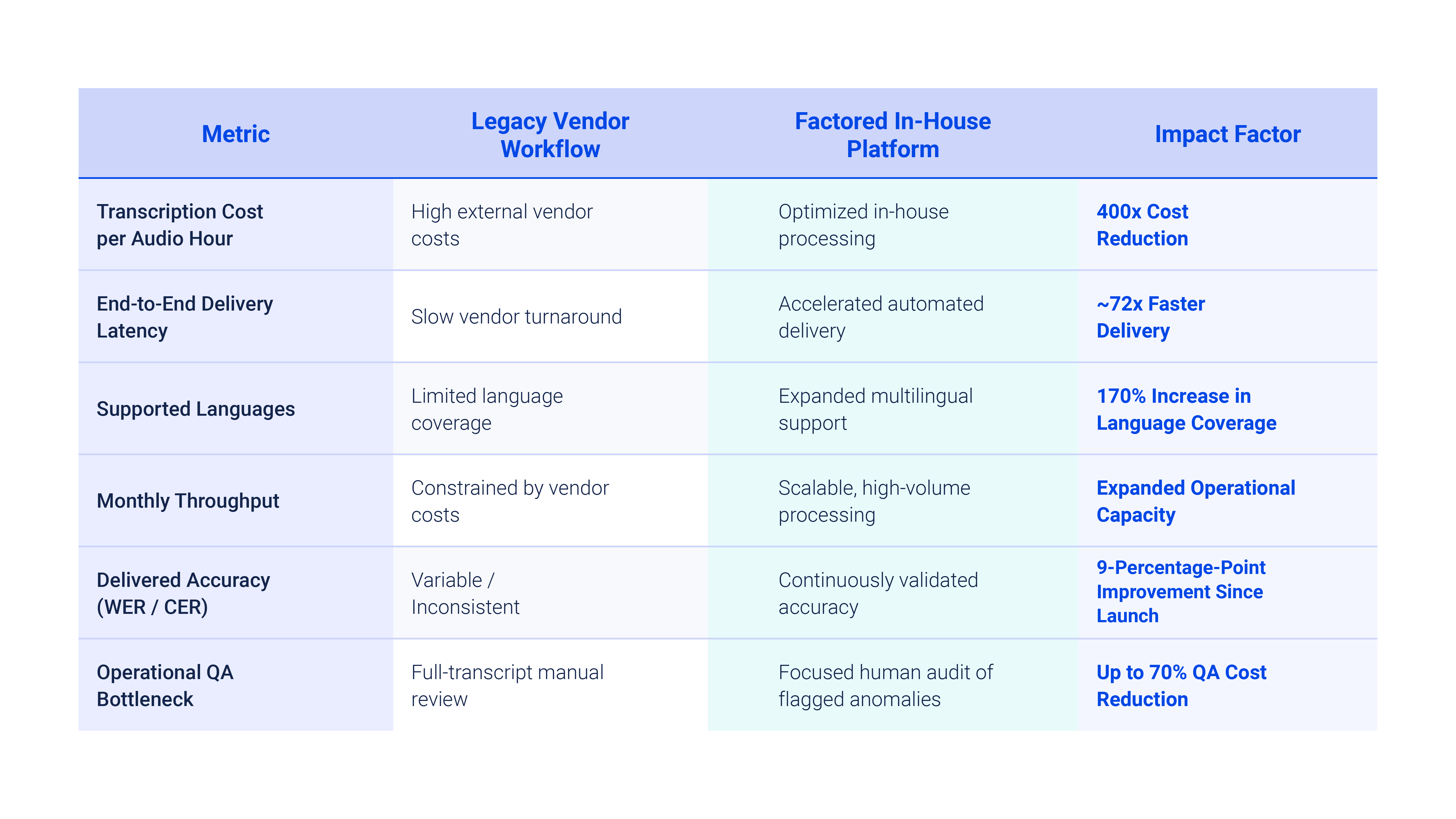
By deploying a modular speech pipeline and pairing it with multi-agent LLM evaluation on Databricks, the organization replaced an external cost center with an internal, scalable intelligence engine.