


By Teogenes Moura
In my years working as a developer across companies both large and small, one thing has become clear: the way an organization structures itself has as much impact on developer well-being as the codebase we work on.
When requirements change without warning, when roles are blurry, when the only constant is urgency, you feel it. Stress creeps in, energy drains away, and eventually burnout sets in. But I’ve also been in environments where priorities were clear, handoffs between product and engineering were smooth, and engineering best practices gave us confidence. In those cases, something simple but powerful happened: people were healthier, the work flowed better, and teams stuck together.
This isn’t a gut feeling. Research has shown that happier developers really do solve problems better, with experiments directly linking positive mood to stronger analytical problem-solving (Graziotin et al., 2014). A later survey of more than two thousand developers revealed that while most reported being “slightly happy,” unclear requirements and organizational politics were among the strongest drivers of unhappiness (Graziotin et al., 2017). And in a systematic review covering over forty studies and thousands of engineers, Godliauskas and Šmite found consistent evidence that well-being is not a side effect but a condition for productivity (Godliauskas & Šmite, 2025).
When Structure Breaks, Developers Pay the Price
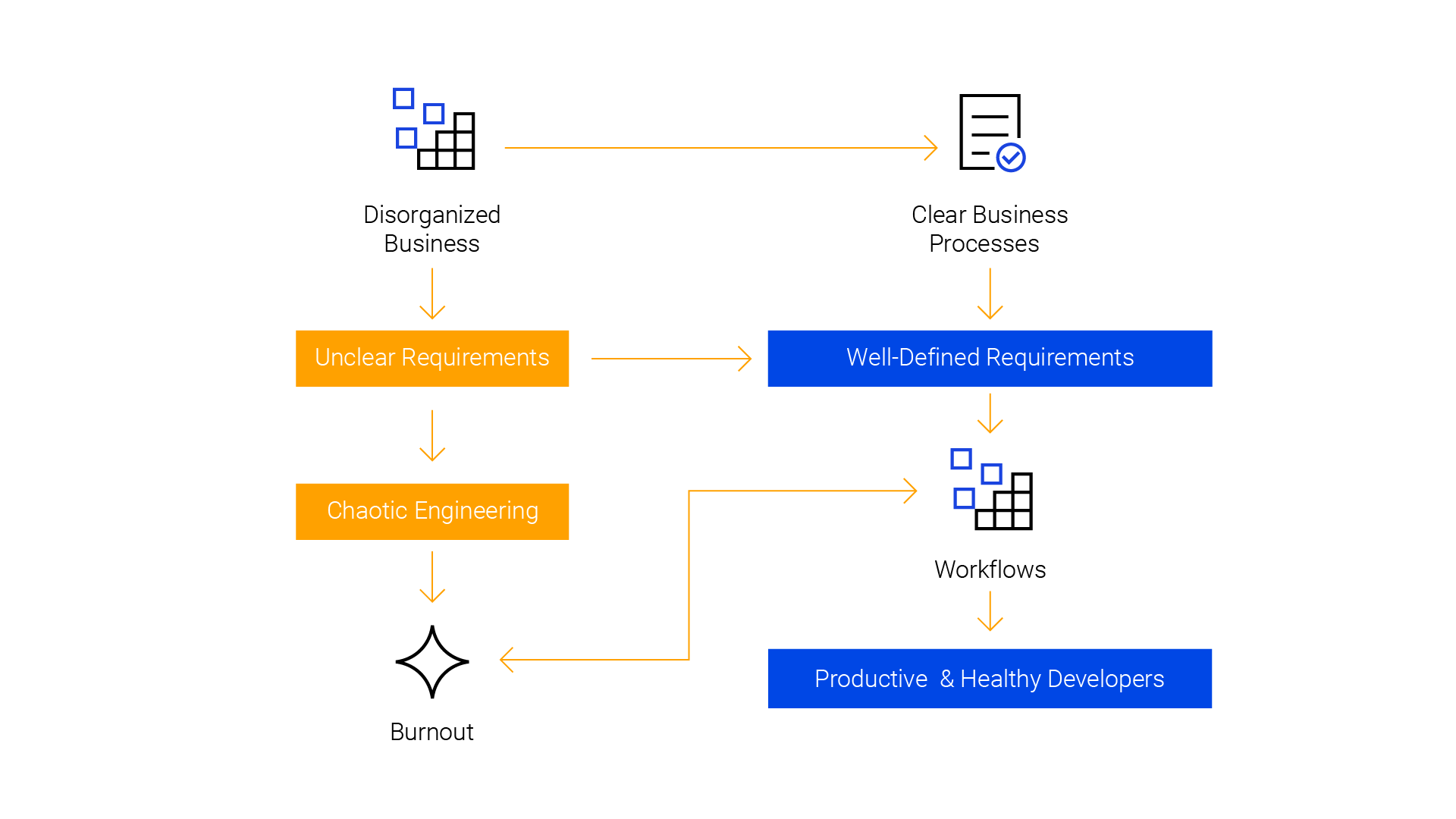
Organizational mess rarely stays confined to a planning meeting, it spreads into the code. A poorly defined business process quickly becomes a poorly defined backlog. Shifting priorities turn into shifting requirements. Gaps in communication create duplicative work, and technical debt piles up faster than anyone can keep up with. Eventually, it all shows in the team’s mental state: frustration, stress, and attrition.
The flip side is equally true. Clear priorities, well-understood roles, and healthy communication ripple outward. A one-page PRD might not look like much, but it stabilizes a sprint. A tech approach document agreed upon by product and engineering becomes an anchor when deadlines are right around the corner. When structure is there, it amplifies stability. And that stability, in turn, protects people’s mental health.
This applies everywhere, from startups with lean rituals moving fast to enterprises where scale creates complexity. The details change, but the pattern doesn’t: clarity sustains people, chaos wears them down.
Practices That Make Work Sustainable
If organizational structure sets the conditions, engineering practices decide how that pressure is felt day to day. Done right, they filter stress instead of passing it straight to developers.
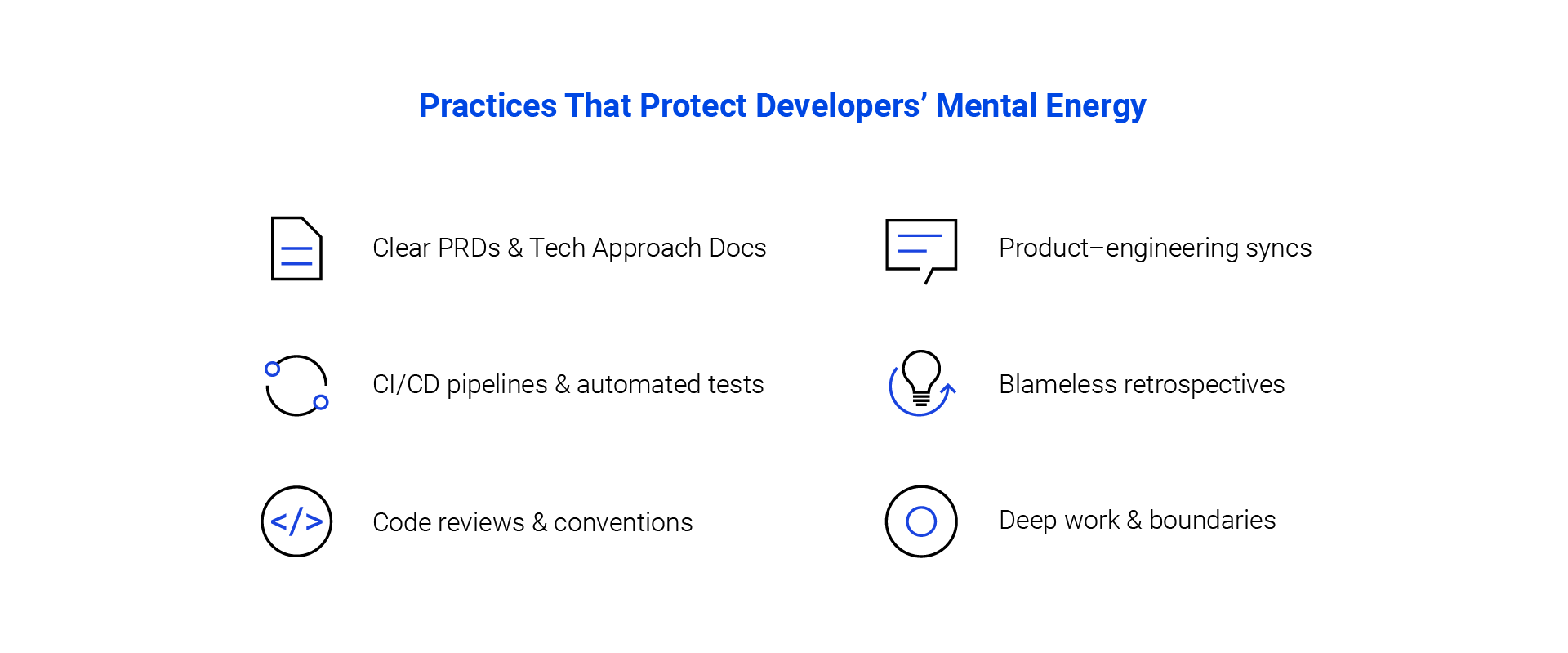
Handoffs are a good place to start. A lightweight Product Requirement Document (PRD) that captures why and what needs to be built, paired with a short technical approach for the how, makes a world of difference. It’s not bureaucracy, it’s a contract that keeps surprises out of the sprint and gives developers something to hold onto when the business shifts.
Engineering discipline is another buffer. CI/CD, automated tests, and code reviews aren’t just about code quality, they’re about peace of mind. When you trust the system to catch regressions, you stop carrying that worry around in your head. The energy you’d spend double-checking yourself goes back into building.
And then there’s the human layer. Psychological safety, the ability to surface problems, admit mistakes, or ask for help without fear. It’s the difference between teams that collapse under pressure and teams that learn from it. Research shows that psychologically safe teams learn more, engage more, and ultimately perform better (Edmondson, 1999). In engineering, that translates directly into healthier, more sustainable development cycles.
Together, these practices don’t erase deadlines or make the work easy. But they make the cost of delivering software something other than people’s health.
Developer Experience Is Human Experience
We talk a lot these days about Developer Experience (DevEx). Some companies even have whole teams dedicated to it, working on internal tooling, documentation, and workflows. But at the core, DevEx is about people. It’s about creating an environment where engineers can do great work without burning out in the process.
Because the cost of ignoring this is too high. Burnout, turnover, and lost productivity are just the visible symptoms. The deeper cost is wasted potential—the ideas never voiced, the solutions never built, and the careers cut short. The systems we design run on machines. But the people who design them are human. And humans need clarity, safety, and care to thrive.
That’s what mental-health engineering really is: not a buzzword, but the foundation of sustainable software development.
References
- Godliauskas, P., & Šmite, D. (2025). The well-being of software engineers: a systematic literature review and a theory. Empirical Software Engineering. https://link.springer.com/article/10.1007/s10664-024-10543-8
- Graziotin, D., Wang, X., & Abrahamsson, P. (2014). Happy software developers solve problems better: psychological measurements in empirical software engineering. PeerJ, 2, e289. https://doi.org/10.7717/peerj.289
- Graziotin, D., Fagerholm, F., Wang, X., & Abrahamsson, P. (2017). On the Unhappiness of Software Developers. Proceedings of the 21st International Conference on Evaluation and Assessment in Software Engineering. https://arxiv.org/abs/1703.04993
- Edmondson, A. (1999). Psychological safety and learning behavior in work teams. Administrative Science Quarterly, 44(2), 350–383. https://doi.org/10.2307/2666999


