How AI-native engineering teams combine automated testing, infrastructure as code, evaluation pipelines, and AI review agents to deploy production systems safely.
Continuous Integration and Continuous Deployment (CI/CD) have become fundamental practices in modern software engineering. By automating the build, testing, and deployment process, organizations can release software faster, reduce manual errors, and increase confidence in production deployments.
A traditional deployment pipeline typically follows a familiar sequence:
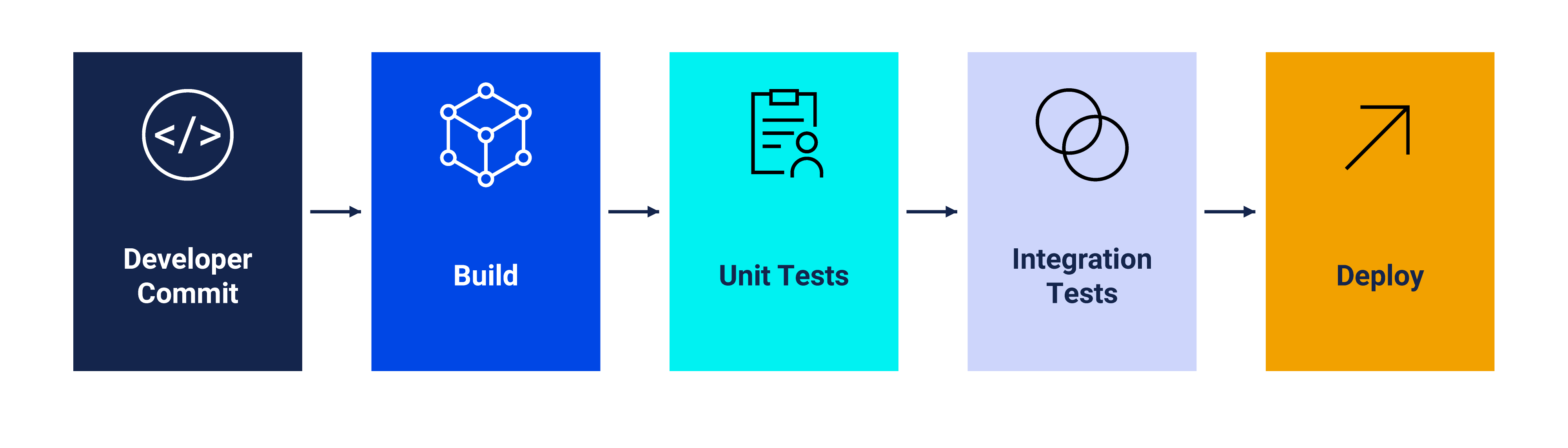
For conventional applications, this approach works remarkably well because the system's behavior is primarily determined by code. Assuming the test suite is representative and well designed, if the application compiles, automated tests pass, and the infrastructure is healthy, there is a high probability that the application will behave correctly in production.
Generative AI applications fundamentally change this assumption.
Modern AI systems are no longer composed solely of application code. Their behavior also depends on prompts, foundation models, retrieval pipelines, vector databases, external tools, agent workflows, and evaluation datasets. Each of these components can change independently, and each can influence the quality of the final response.
As a result, a deployment can be technically successful while still delivering a poor user experience. The API may return a successful HTTP response, infrastructure monitoring may report that every service is healthy, and yet the application may generate incorrect, incomplete, or unsafe answers.
Unlike traditional software, where correctness is often determined through deterministic tests, GenAI systems must also be evaluated for behavioral qualities such as factual accuracy, faithfulness, safety, and consistency. These characteristics cannot be verified through conventional unit or integration tests because multiple outputs may be valid, and semantic quality cannot be expressed as a simple pass/fail assertion.
This shift requires us to rethink what CI/CD means for GenAI applications. Instead of validating only whether the application runs correctly, modern deployment pipelines must continuously validate whether the GenAI system behaves as expected.
Why Traditional CI/CD Breaks for GenAI Systems
Consider a simple REST endpoint:
In a traditional application, an integration test might verify that the endpoint is available and returns a successful response.
From a software engineering perspective, the test passes.
Now imagine the application answers the following question:
What is the capital of Germany?
with:
Nothing in the deployment pipeline failed. The application started successfully, the infrastructure remained healthy, and every automated test passed. Yet the system delivered an incorrect answer to the user.
This simple example illustrates why traditional CI/CD is insufficient for GenAI applications.
Traditional CI/CD is designed around the assumption that software behavior can be validated through deterministic checks. It gives teams confidence in properties such as:
- Functional correctness: Does the application produce the expected result for a given input?
- Interface correctness: Do APIs and integrations behave according to their contracts?
- Deployment correctness: Can the application be built and deployed successfully?
- Infrastructure health: Are the services and resources required by the application operating correctly?
For these systems, well-designed automated tests can provide strong evidence that the deployed application will behave as expected.
GenAI systems introduce a different class of validation problems. The question is no longer only whether the application is functioning correctly from a software perspective, but whether it is producing useful, accurate, safe, and trustworthy outcomes.
For example:
- Response quality: Are responses factually correct, relevant, and complete?
- Grounding: Is the response supported by the retrieved context?
- Retrieval quality: Is the system retrieving the information needed to answer the question?
- Security: Does the application resist prompt injection and other adversarial attempts?
- Operational efficiency: Are latency and inference costs within acceptable limits?
- Consistency: Does the system behave reliably across repeated executions?
These properties cannot be adequately validated through conventional unit and integration tests alone. Multiple outputs may be valid even when they differ in wording, while qualities such as factual accuracy, faithfulness, and safety are often semantic rather than binary.
The challenge becomes even greater because a modern GenAI application is not a single model or a single piece of application code. Its behavior can depend on prompts, foundation models, retrieval pipelines, vector databases, external tools, agent workflows, and other interconnected components. Each can change independently and influence the final response.
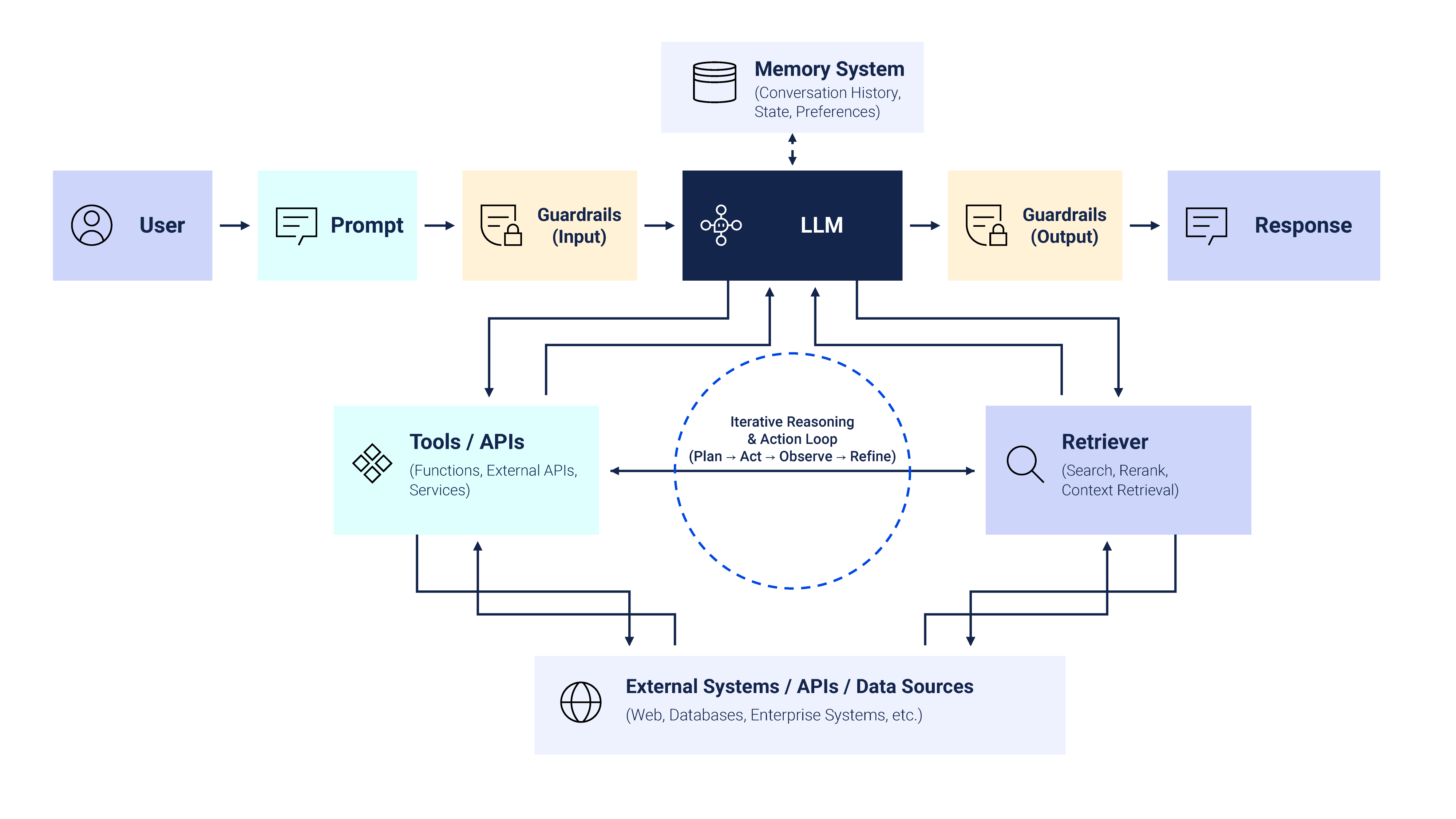
The LLM interacts iteratively with retrieval systems, tools, external data sources, and memory, while guardrails control inputs and outputs. Changes to any of these components can influence the behavior and quality of the final response.
Each layer introduces its own potential failure modes.
A prompt update may increase hallucinations. A retrieval change may return irrelevant documents. A tool integration may fail unexpectedly. An agent may choose an incorrect sequence of actions, even though every individual component is functioning correctly.
Traditional CI/CD assumes that validating individual software components is enough to guarantee the behavior of the entire application. GenAI systems challenge this assumption because the overall quality emerges from the interaction between multiple components, many of which are probabilistic rather than deterministic.
For this reason, modern GenAI deployment pipelines must evolve beyond software testing. They need to validate not only whether the application works, but whether the system produces reliable, trustworthy, and high-quality outcomes.
Building an GenAI-Native CI/CD Pipeline
If traditional CI/CD validates that an application works, AI-native CI/CD must validate that an GenAI system behaves as expected.
That requires expanding the deployment pipeline beyond software testing.
A mature GenAI pipeline should validate multiple aspects of the system, from application correctness to response quality, security, and operational performance.
A typical workflow might look like this:
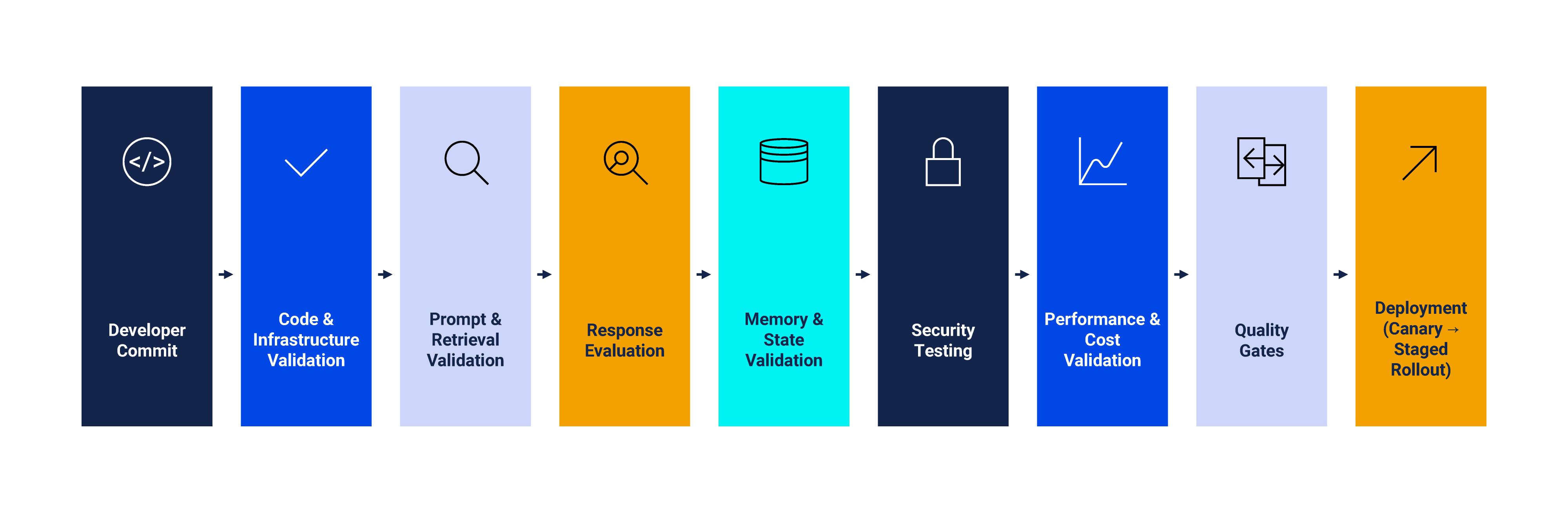
Each stage focuses on a different source of risk, providing confidence that the system is ready for production.
Layer 1: Software Validation
The foundation of every GenAI application is still reliable software. Before AI-specific evaluations, the pipeline should validate the application using standard engineering practices:
- Unit and integration tests
- API tests
- Static analysis and dependency scanning
- Container builds
These checks ensure the application is technically sound before evaluating AI-specific behavior.
Reliable GenAI systems are built on reliable software.
Layer 2: Prompt and Retrieval Validation
Unlike traditional applications, much of a GenAI system's behavior is defined outside the source code.
Prompt templates determine how the model interprets requests, retrieval systems decide which information is provided as context, and orchestration logic controls how models interact with tools and external services.
A seemingly minor prompt modification can dramatically change system behavior. For example, replacing:
Answer the question.
with:
Answer only using the retrieved context. Do not make inferences beyond what is explicitly stated.
may significantly reduce hallucinations without changing a single line of application code.
For this reason, prompts should be treated as production assets. They should be version controlled, reviewed through pull requests, and deployed using the same engineering discipline applied to source code.
Retrieval systems deserve similar attention. In Retrieval-Augmented Generation (RAG) applications, the model can only generate answers based on the information it receives. If the retrieval layer fails to provide the necessary context, even the most capable language model cannot produce a grounded response.
Instead of evaluating only the final answer, mature pipelines also monitor retrieval quality using metrics such as:
- Precision@K - What percentage of retrieved documents are relevant?
- Recall@K - What percentage of all relevant documents were retrieved?
- Mean Reciprocal Rank (MRR) - How highly ranked is the first relevant document?
- Normalized Discounted Cumulative Gain (NDCG) - How well does ranking quality improve with more results?
These metrics help teams identify whether declining answer quality originates in the retrieval layer rather than in the model itself.
Treating prompts and retrieval as first-class deployment artifacts allows organizations to detect regressions long before they reach production.
Layer 3: Response Evaluation
Traditional software testing often relies on deterministic assertions: given a specific input, the system is expected to produce a predictable output. LLM-based applications behave differently. Multiple responses can be valid even when they differ in wording, making exact string comparisons insufficient for many GenAI use cases.
Instead, CI/CD pipelines need evaluation methods that assess whether a response meets the quality requirements of the application.
The goal of response evaluation in the deployment pipeline is not to determine how to improve the model. It is to answer a simpler operational question:
Does this version of the application meet the minimum quality bar required for deployment?
Evaluation Methods
The appropriate evaluation method depends on the type of output and the behavior being validated. Common approaches include:
- Exact Match: Useful for deterministic or structured outputs, such as JSON fields, classification labels, or specific codes.
- Semantic Similarity: Compares the meaning of a response rather than requiring an identical wording.
- LLM-as-a-Judge: Uses another language model to evaluate dimensions such as correctness, relevance, faithfulness, completeness, or safety.
In practice, a pipeline may combine several methods. For example, structured outputs can be validated deterministically, while open-ended responses can be evaluated using semantic similarity or an LLM-based evaluator.
Evaluation Datasets
Response evaluation requires a representative set of test cases that can be executed automatically during the pipeline.
The evaluation dataset should include:
- Normal cases: Common requests the application is expected to handle.
- Edge cases: Unusual but valid inputs that may expose weaknesses.
- Failure scenarios: Inputs designed to test known failure modes.
- Representative diversity: Variation in input length, complexity, language, and other characteristics relevant to the application.
The dataset should be treated as a versioned CI/CD artifact. A deployment should be evaluated against a known dataset version so that results are reproducible and quality gates are applied consistently.
Layer 4: Stateful Application Validation (Optional)
Not every GenAI application maintains state across requests. Many production systems, such as document summarization, translation, report generation, or offline content creation, process each request independently and do not require conversation history or persistent memory.
However, conversational assistants, AI agents, and copilots often rely on stateful components to deliver coherent multi-turn interactions. These systems store information such as conversation history, user preferences, or workflow state, making state management another critical aspect of the deployment pipeline.
For applications that maintain state, CI/CD should validate not only response quality but also whether state is handled correctly, securely, and efficiently.
4.1 Conversation History Compatibility
Changes to prompts, models, or retrieval pipelines can alter how previous conversation history is interpreted. A new model version may consume context differently, require different prompt structures, or produce degraded responses when presented with existing conversations.
Validation should verify that representative conversation histories from production remain compatible with the new application version.
Typical checks include:
- Loading historical conversations into the updated system
- Verifying that responses remain coherent across multiple turns
- Measuring context window utilization and token efficiency
- Detecting regressions caused by prompt or model changes
4.2 Conversation Isolation and Privacy
Conversation history frequently contains sensitive user information. Deployment pipelines should verify that conversations remain properly isolated and that users cannot access another user's data.
Validation should include:
- Session isolation tests
- Authorization checks on conversation retrieval
- Encryption verification for stored conversation history
- Data retention and deletion policy validation
4.3 Context Growth and Performance
As conversations become longer, more context must be processed during inference. Larger contexts increase token consumption, latency, and cost, and may eventually exceed the model's context window.
CI/CD should evaluate how the application behaves under realistic conversation lengths by measuring:
- Context injection latency
- Token consumption over long conversations
- Response latency as context grows
- Cost per conversation
These tests help ensure that the application remains responsive as conversations evolve.
4.4 Conversation State Robustness
Stateful systems should remain reliable even when conversation history is incomplete, corrupted, or intentionally manipulated.
Validation should include scenarios such as:
- Corrupted or malformed conversation history
- Missing conversation state
- Adversarial attempts to manipulate stored context
- Recovery after interrupted workflows
The goal is to ensure that invalid or malicious state does not degrade future responses or compromise application behavior.
Stateful Validation Gates
For applications that maintain conversation state, organizations may define quality gates such as:
- Conversation retrieval success ≥ 95%
- Session isolation = 100%
- Context injection latency within SLA
- Zero unauthorized conversation access
- No conversation corruption detected
Applications that do not maintain persistent state, such as batch documents processing or stateless inference APIs can omit this validation entirely.
Layer 5: Security Validation
GenAI systems introduce new security risks because prompts can influence model behavior and, in agentic applications, models may have access to tools, data, and external systems.
Security validation should therefore go beyond traditional vulnerability scanning. CI/CD pipelines should test scenarios such as:
- Prompt injection and jailbreak attempts
- System prompt extraction
- Unauthorized data access
- Unauthorized tool or API usage
- Attempts to bypass application guardrails
For applications that use tools or agents, security also depends on controlling what the system is allowed to do. Tools should follow the principle of least privilege, granting only the permissions required for their intended operation. Access to sensitive data, APIs, and external systems should be explicitly scoped and independently enforced rather than relying solely on the model to follow instructions.
Security evaluations can then be used as deployment gates, with critical failures blocking promotion. The exact thresholds should be defined according to the application's risk profile rather than applying a universal set of numbers.
The goal is not to prove that a GenAI system is completely secure, but to continuously test known attack scenarios and ensure that the system's capabilities are appropriately constrained.
Layer 6: Operational Validation
High-quality responses alone are not enough. A GenAI application must also operate efficiently, reliably, and within acceptable cost constraints. However, the operational metrics that matter depend on how the application is deployed.
For interactive GenAI applications, such as chatbots, copilots, and AI agents, user experience depends on low latency and responsive interactions. Before deployment, CI/CD pipelines should validate metrics such as:
- Response latency (P50, P90, P99)
- Token consumption per request
- Inference cost per request
- Throughput (requests/second)
- GPU and CPU utilization
For batch GenAI applications, such as document summarization, large-scale content generation, translation, or offline report generation, latency for an individual request is often less important than overall processing efficiency. Instead, pipelines should validate metrics such as:
- Total batch execution time
- Documents or records processed per hour
- GPU and CPU utilization
- Total inference cost per batch
- Queue processing time
- Failure and retry rates
- Checkpoint and recovery mechanisms for long-running jobs
Monitoring these operational characteristics during CI/CD allows teams to detect performance regressions before they affect production workloads or significantly increase infrastructure costs.
Regardless of whether a system serves interactive users or batch workloads, operational validation ensures that improvements in response quality do not come at the expense of unacceptable latency, scalability, or cost.
Cost-Aware Evaluation Pipelines
A mature GenAI CI/CD pipeline can become expensive as the evaluation suite grows. A single change may require:
- 1,000 LLM calls for response evaluation
- 500+ retrieval queries for RAG benchmarking
- 200+ adversarial prompts for security testing
- Latency and resource measurements across environments
The actual cost depends on the models used, token consumption, infrastructure, and evaluation strategy. Execution time also varies significantly depending on whether evaluations are run sequentially or in parallel.
For teams deploying multiple times per day, running the complete evaluation suite on every change can therefore become unnecessarily expensive and slow.
Smart Evaluation Sampling
A better approach is to use progressive evaluation: start with a small, fast evaluation suite and progressively increase coverage as a change moves closer to production.
Commit-Level Evaluation — Fast Feedback
- Run a small representative sample, such as 50–100 test cases
- Use smaller or specialized evaluation models where appropriate
- Prioritize high-risk scenarios
- Run evaluations in parallel where possible
- Goal: provide rapid feedback during development
Pre-Staging Evaluation — Increased Coverage
- Expand to 300–500 test cases
- Use more capable evaluation models when required
- Include retrieval benchmarking
- Expand security and edge-case coverage
- Goal: provide stronger confidence before production
Production Gate — Comprehensive Evaluation
- Run the complete evaluation suite, potentially 1,000+ cases
- Apply multiple evaluation methods to critical metrics
- Run comprehensive security and consistency testing
- Validate operational metrics under production-like conditions
- Goal: maximize confidence before release
The important point is that evaluation time should be treated as a pipeline characteristic rather than a fixed value. Teams should measure the execution time of their own evaluation stages and optimize them through techniques such as parallel execution, caching, sampling, and model selection.
The key insight: Not every change requires full evaluation.
A documentation update may require only basic validation. A prompt change may require response evaluation. A retrieval change may require retrieval and end-to-end RAG evaluation. A foundation model change may require a comprehensive evaluation suite.
This change-aware approach allows teams to balance evaluation confidence, execution time, and cost without slowing down every deployment unnecessarily.
Cost Optimization Strategies
1. Progressive Evaluation Gating: Run cheaper tests first and fail fast. Only run expensive evaluations if cheaper gates pass.
2. Evaluation Model Selection Smaller, cheaper models can often perform evaluation tasks effectively:
- Factual correctness and complex reasoning: Use a frontier model when high-quality judgment is required (e.g., GPT-5.6, Luna, or similarly capable models).
- Semantic similarity: Use embedding models or open-weight models to compare the meaning of responses without requiring a large language model.
- Safety and policy compliance: Specialized safety classifiers or smaller instruction-following models are often sufficient for detecting prompt injection attempts, policy violations, or unsafe outputs.
- Structured output validation: Prefer deterministic rule-based validation whenever possible instead of an LLM.
When selecting evaluation models, consider both cost and the level of reasoning required for the task. Public LLM leaderboards can provide useful guidance on the relative capabilities of different model families, helping teams match evaluation complexity to the most appropriate model instead of defaulting to the largest one.
3. Staged Thresholds with Monitoring: Deploy to production with monitoring rather than pre-deployment perfection. If quality metrics degrade beyond thresholds during the canary phase, automatic rollback triggers.
Deploying GenAI Systems with Confidence
As GenAI systems grow in complexity, running every validation for every change quickly becomes impractical. Some evaluations may require thousands of LLM calls, retrieval benchmarks, or security probes, making them both time-consuming and expensive.
A mature AI CI/CD strategy balances confidence with efficiency by executing only the validations that are relevant to each change.
Change-Aware Pipelines
Not every modification introduces the same level of risk. Updating application code, modifying a prompt, or changing infrastructure each affects different parts of the system and should trigger different validation workflows.
For example:
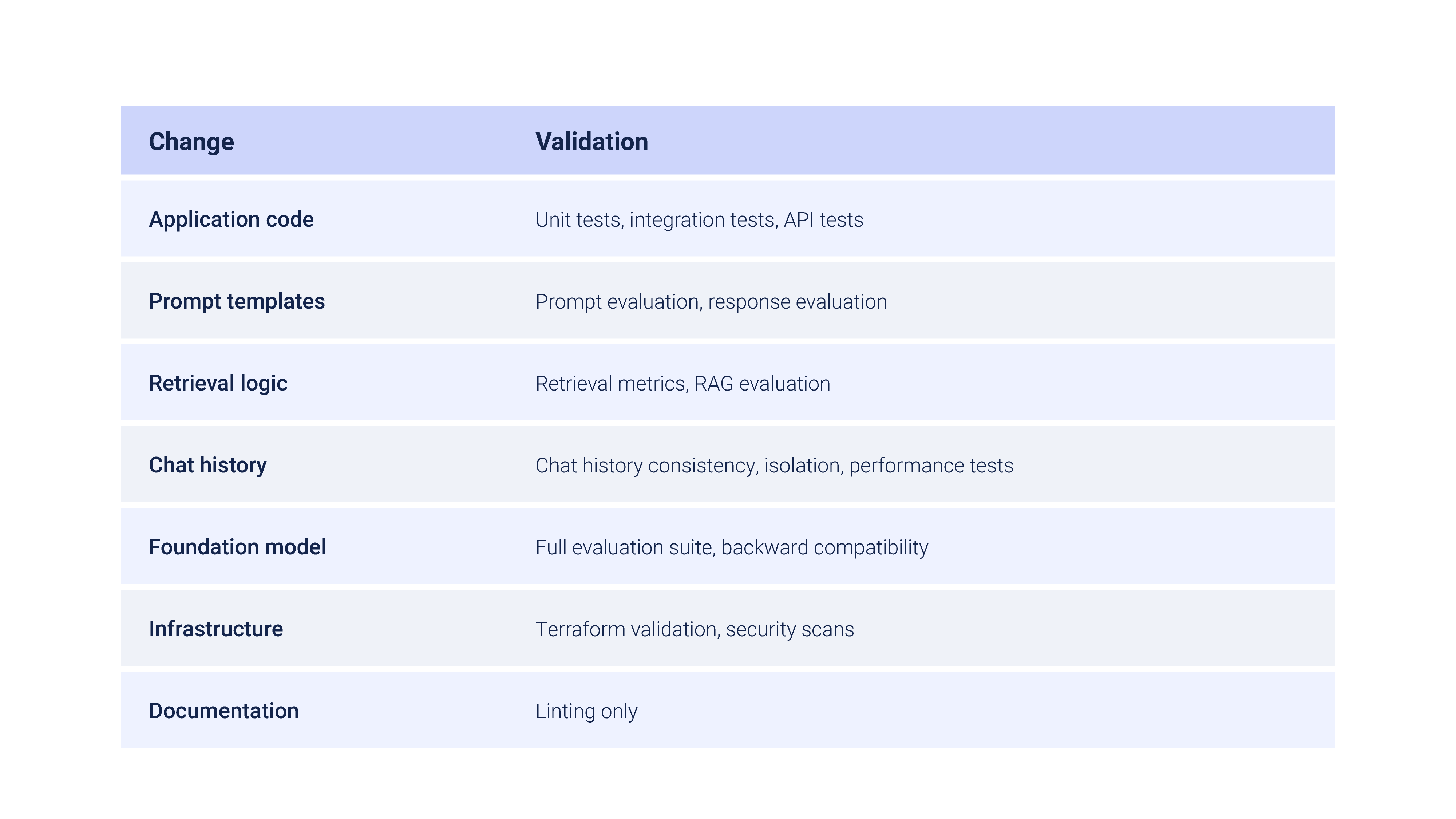
Instead of executing every validation step on every commit, the pipeline focuses on the areas impacted by the change. This approach significantly reduces execution time while ensuring that critical validations are never skipped.
Environment-Specific Validation
Validation requirements should also evolve as code moves through the deployment lifecycle.
During development, the primary goal is rapid feedback. Engineers need to know within minutes whether a change introduced obvious regressions, allowing them to iterate quickly.
A lightweight validation suite typically includes:
- Unit and integration tests
- Static analysis
- Prompt validation
- A small evaluation dataset
Once changes are promoted to a staging environment, the objective shifts from speed to confidence. This is where organizations execute comprehensive evaluations before exposing the system to production traffic.
Typical staging validations include:
- Full evaluation datasets
- Retrieval evaluation
- LLM-as-a-Judge
- Security testing
- Latency and cost validation
- Consistency testing
Finally, production deployments should be protected by quality gates that define the minimum acceptable performance for the application. Only versions that satisfy these requirements are promoted.
This progressive approach allows teams to maintain fast development cycles while still applying rigorous validation before production.
Infrastructure as Code
Deploying an AI application involves much more than releasing application code.
Production systems often depend on cloud infrastructure such as Kubernetes clusters, vector databases, object storage, model registries, monitoring platforms, and GPU resources. Managing these components manually quickly becomes error-prone and difficult to reproduce.
Infrastructure as Code (IaC) addresses this challenge by defining cloud resources declaratively and versioning them alongside the application. Tools such as Terraform allow infrastructure changes to follow the same engineering practices applied to software development, including peer review, version control, automated validation, and rollback capabilities.
Separating infrastructure deployments from application deployments also reduces operational risk. A common pattern consists of two independent pipelines:
- Infrastructure Pipeline, responsible for networking, storage, compute resources, monitoring, and security.
- Application Pipeline, responsible for APIs, prompts, models, evaluation, and deployment.
This separation enables infrastructure to evolve independently while keeping application releases fast and predictable.
A Practical GenAI CI/CD Workflow
Bringing these practices together results in a deployment pipeline that continuously validates both the technical implementation and the behavior of the GenAI system.
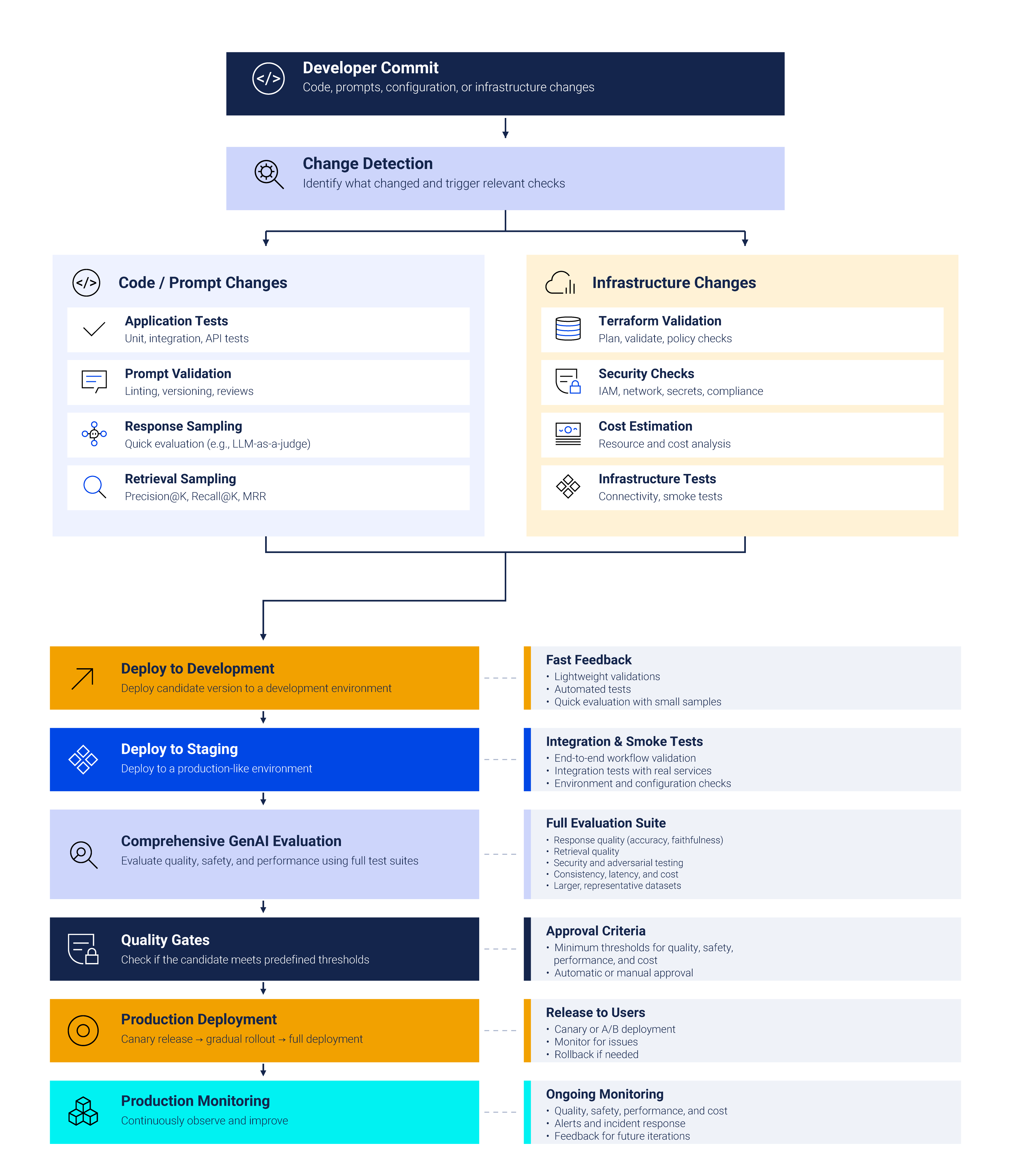
Canary Deployments and Gradual Rollout
Rather than deploying to all users at once, gradually expose new versions:
Canary Phase (Safety Verification)
- Deploy to 5% of traffic
- Monitor for 2-4 hours
- If metrics healthy → continue
- If metrics degrade → automatic rollback, investigate
Graduated Rollout (Risk Reduction)
- If canary healthy: increase to 25% of traffic
- Monitor for 4-8 hours before advancing
- Progressively: 50% → 75% → 100%
- Each stage verified before advancing to the next
This approach provides multiple opportunities to detect issues before full production exposure.
Automatic Rollback Triggers
Define clear thresholds for automatic rollback without human intervention:
These automatic safety mechanisms provide confidence even when deploying at scale.
Final Thoughts
Continuous Integration and Continuous Deployment have transformed the way software is delivered, but GenAI applications require us to expand what "continuous validation" means.
Modern GenAI systems are composed of much more than application code. Prompts, models, retrieval pipelines, memory systems, agents, and evaluation datasets all influence the behavior of the final application, and each of these components must be versioned, tested, and deployed with the same engineering discipline traditionally applied to software.
Successful AI organizations are not necessarily those with the most advanced models, but those with the most robust engineering practices around them. As AI becomes increasingly integrated into business-critical systems, the organizations that win will be those that can deploy GenAI systems reliably, measure their quality rigorously, and iterate safely at scale.